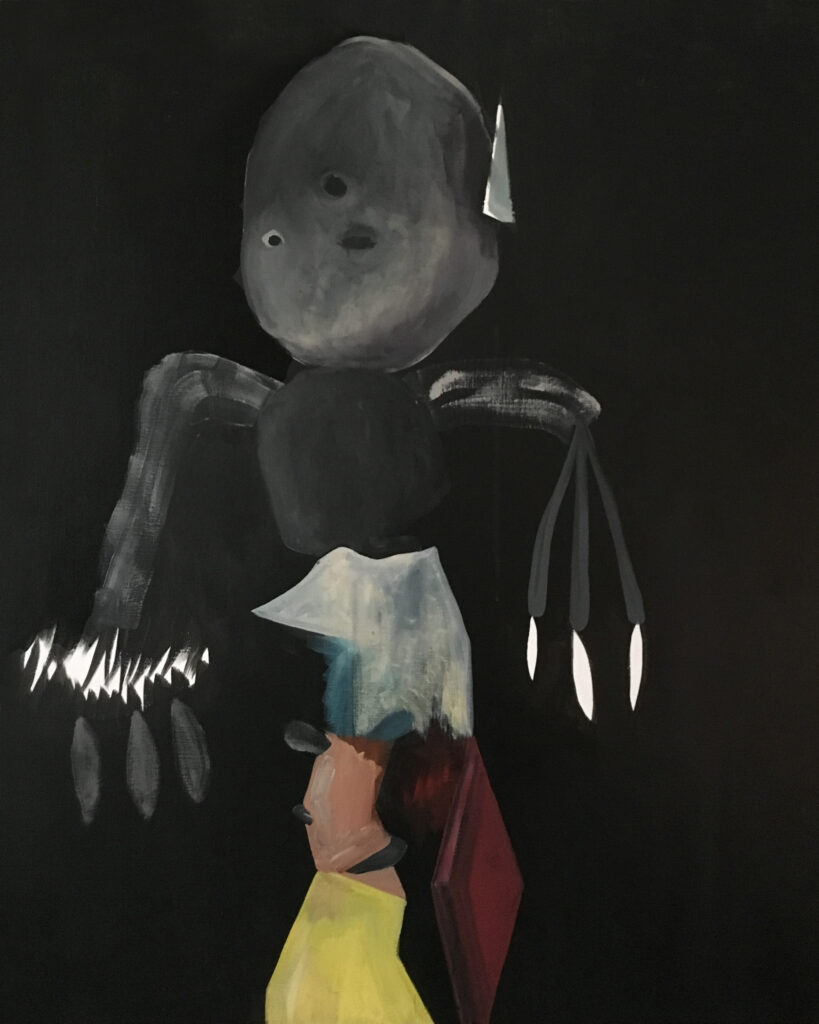
Jean Michel Alberola was born in 1953. In the early 1980s, he was part of a renewed, favorable trend in painting that other artists of the same generation - Jean-Charles Blais and François Boisrond, for example - continue to pursue today: conceptual figuration, combining solid training in drawing, experimentation with bold colors and theoretical reflection on the act of painting itself. An iconographic herbalist, Alberola gathers, assembles and assembles. Drawing is undoubtedly privileged, and the line both emphasizes and homogenizes the abruptness of rapprochements and superimpositions. The painter is indeed practicing collage, but without any real documentary objects gathered at random and glued to the canvas, as was the case with the cubists and surrealists. Alberola sketches and suspends meaning. More precisely, he suggests and differs. «As in cinema,» you might say: things slip from one image to another, color contrasts mark transitions, transfusions and modulate blends. And then the writing takes over. It doesn't just comment on or «caption» the image. It IS the image. What is read is seen, and vice versa... Alberola's works take on the appearance of a rebus, and reflect a highly specific talent in contemporary art for bringing together, concatenating and assembling. They are reminiscent of those childhood pastimes that the philosopher Walter Benjamin (widely read by the painter) enumerates in the unpacking of his library: «painting, cutting, transferring». Painting is therefore synonymous with editing for Alberola, and this is what, in many ways, brings his method and visual results so close to Jean-Luc Godard's Histoire(s) du cinéma. What's more, for Alberola, painting means leaving, traveling. His passion for Stevenson attests to this. One might evoke an aesthetic of the diverse, in reference to Victor Segalen. His paintings and prints are expanses where the imaginary interdependence of literature and travel is realized. This explains Alberola's reverence for painting as an ultra-sensitive surface (film?) through which the chemistry of recording ideas and memories is precipitated. Cinema permeates the whole of Alberola's work, to the point of suggesting that paintings, prints and books are infused with the art of film. Beyond the numerous cinephilic references inscribed on the surface of his canvases, the seamless passages and contaminations between forms are the result of a mental functioning «in» constellation. The metamorphoses of the objects represented, the sketched characters and their labile faces, the superimpositions or alternations of an image and its opposite in reference to «positive/negative» oscillations, refer ontologically to cinema. In 2019, I invited Jean-Michel Alberola to take part in the exhibition (1) I co-curated with Claudine Grammont: CINÉMATISSE, devoted - as the title cavalierly announces - to the relationship that the painter, a glory of modern art, had with cinema, in a rather secret but intense and very cinephilic way: a relationship little-known (and unsurprisingly) to all specialists (2) in the work of a painter who was often reduced to the reassuring legacy of his peers and predecessors in his discipline. For this occasion, Jean-Michel Alberola chose to create an original work rather than present an old one. He thus created Cinéma Tahiti, in reference to Matisse's meeting with Friedrich Wilhelm Murnau in Tahiti in 1930. The work is exemplary of his style: his intellectual method borrows from note-taking and the «reminders» of a diary, and his very «Matissian» style risks the abstract flat tints of the painter's last period. Alberola's contrasting harmonies of color and illusorily logical graphic facetiousness (arrows, numbers, telephone numbers, etc.) depict the conversations of these two giants of 20th-century art, who, on the face of it, were neither predisposed to chat and enjoy each other's company, nor to be reunited for posterity through photography, which they both practiced, leaving images that are reminiscent of our ordinary, intimate contemporary selfies! This encounter has been documented and commented on for several years.
Matisse stayed in Tahiti while the German filmmaker shot his final film, Tabou (a car accident prevented him from accompanying its commercial release). Matisse saw the film several times. It left a lasting impression on him (and he was saddened by the filmmaker's untimely death), memories of which would persist in several series of drawings almost fifteen years later (3). The intellectual and friendly bond that developed between the two men is not as surprising as the coincidence of this island colloquium might suggest. Matisse was no stranger to the work of painters associated with the Blaue Reiter movement.
Murnau is far removed from German «expressionist» figuration in cinema, dominated by «caligarism», a distance accentuated by his Hollywood adventure (Dawn, City Girl, Taboo). On the other hand, in Nosferatu, certain landscapes and the animal presence in the landscape reveal the inspiration of Franz Marc's work. This common expressionist link between the French painter and the German filmmaker may also have animated their closeness beyond (or beyond) words.
Dominique Païni, Jean-Michel Alberola : l'art documente l'art, 1895, revue d'histoire du cinéma, n° 100, automne 2023, pp. 39-40.