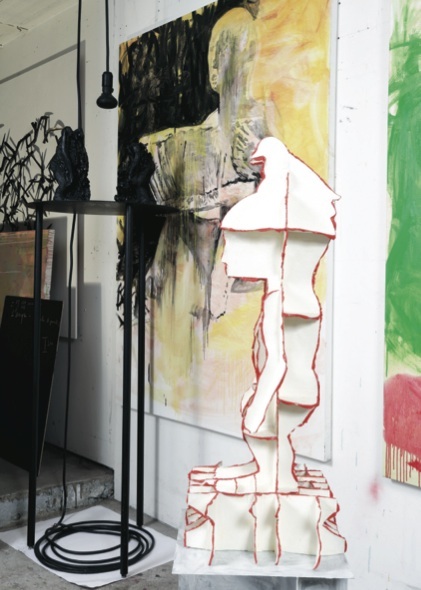
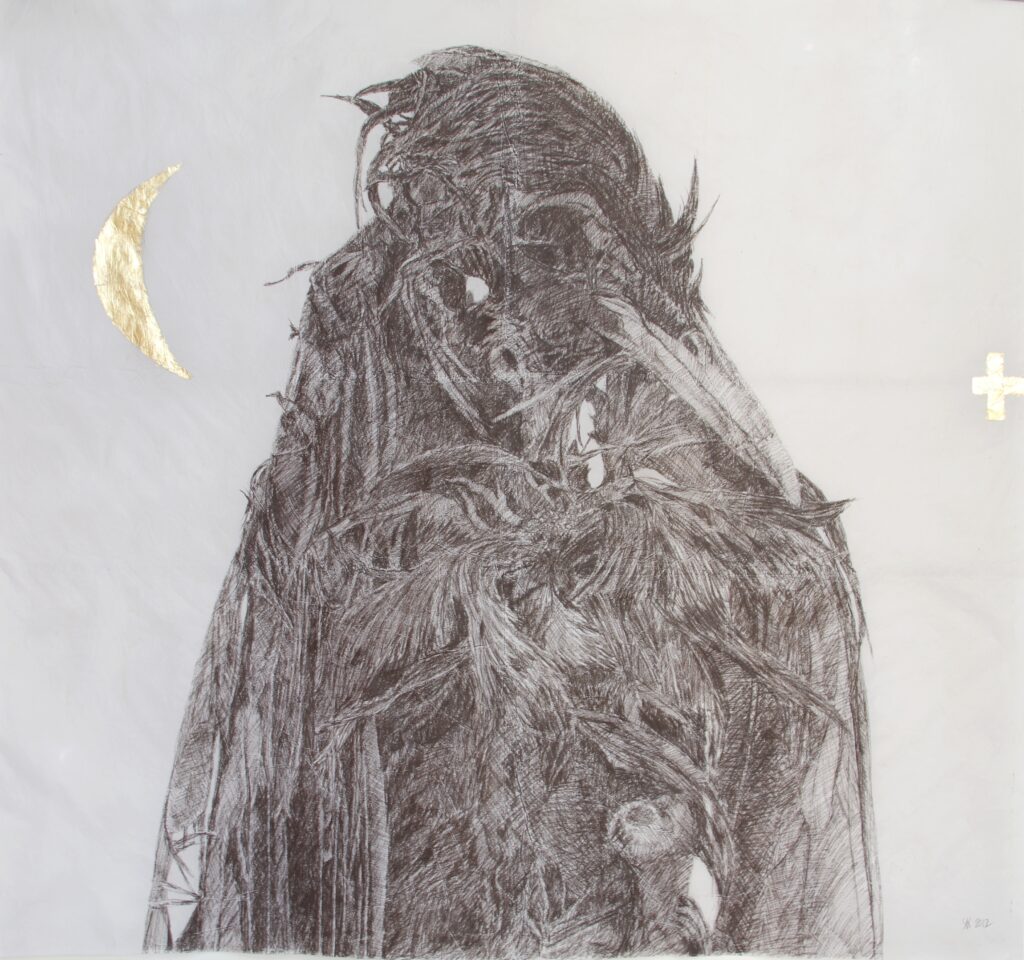
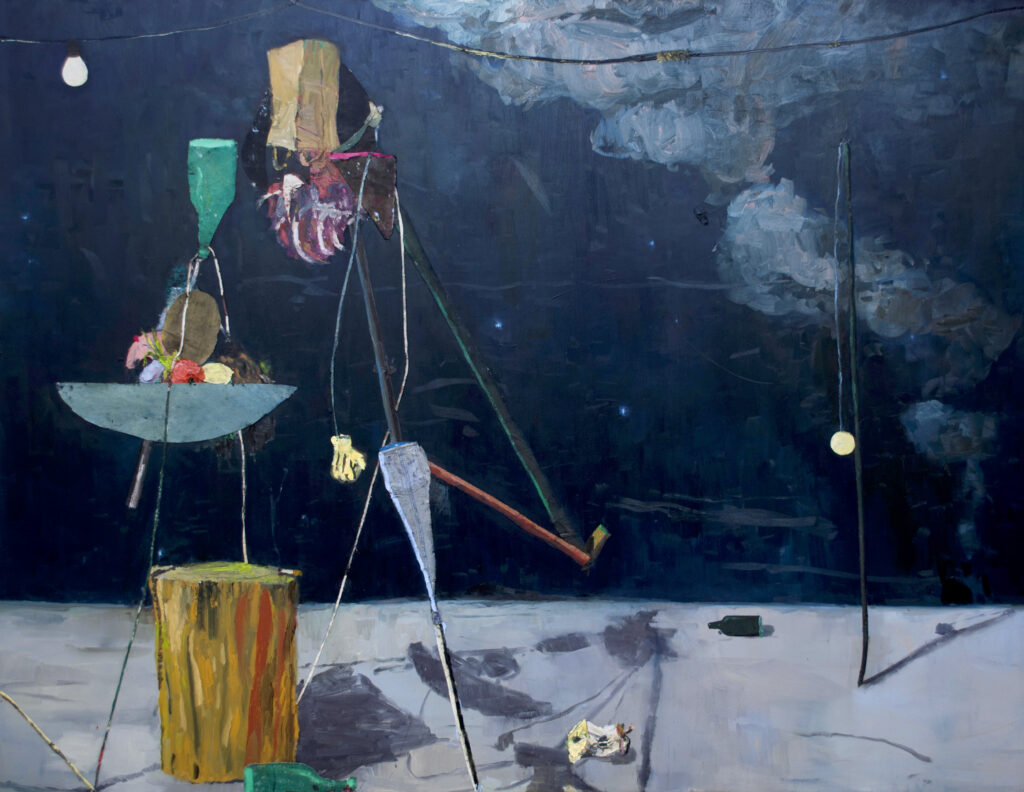
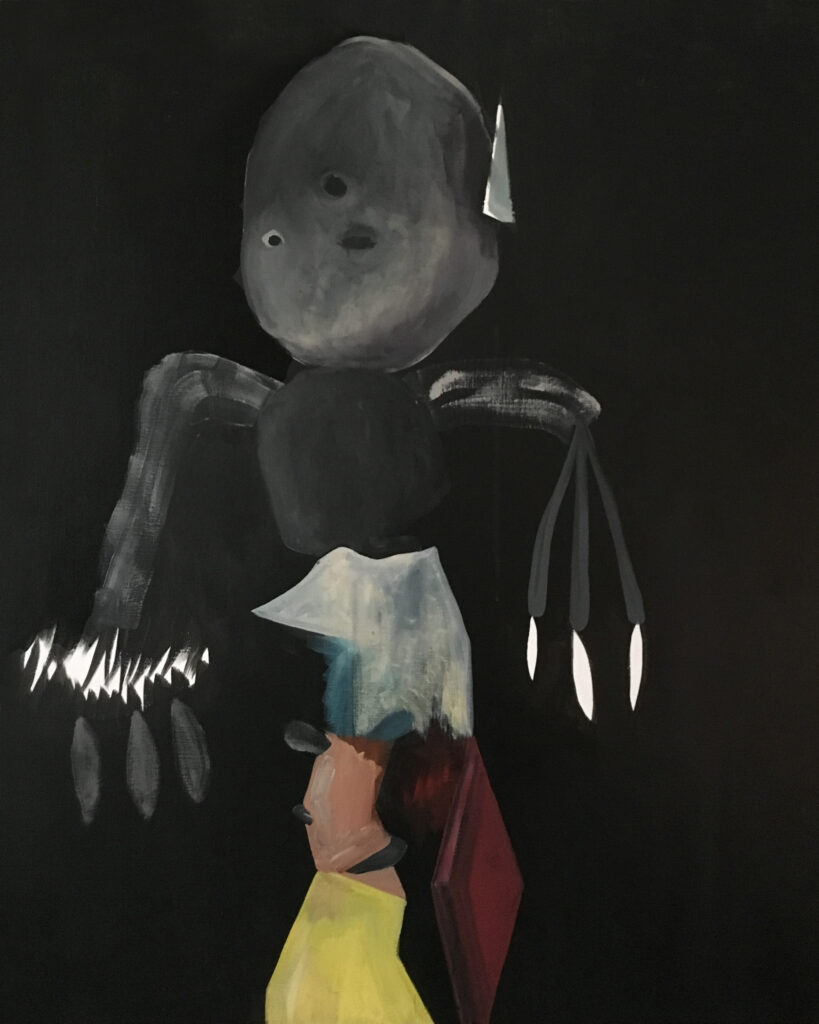
We recognize in Fritz Bornstück's paintings some similarities with the scarecrows planted in fields or with the plastic gnomes, the plaster sculptures of deer, the antique statues in concrete, the lions and the rabbits... that we observe in amusement in the charming gardens randomly spotted on a walk. These worlds that we imagine to be parallel to ours, solely because we take no care of them, obey logics that are no more implausible than those of the wars we wage or the disorders we organise which leave behind them ruins and piled up waste. See the life that develops in the jumble of bushes and flowerbeds, in the intertwining of branches, of roots, of leaves, of blooming or dried flowers, of empty cans, of multi-coloured birds, of bottles and cigarette butts. Here, a dung beetle rolls a ball of dung in the shape of a skull, unless he’s actually walking around with a tiny human skull the size of an insect; elsewhere, a young girl made of scrap metal, with limbs made out of table legs and wearing a red dress, waves a flag and holds by the shoulder a young man identical to her, dressed in a purple watering can; they are alone, happy and in love in the forest where old basins are piled up. Fritz Bornstück paints seemingly incongruous assemblages made of metal carcasses and old machines, worn and empty, abandoned in woods and meadows. But, as we know, nature herself uses curious artifices; we know the strange stratagems through which takes place the birth of the flowers which attract the insects who will pollinate them and we are not unaware of the complicated rules which transform the caterpillar into a butterfly or those which incite snakes to moult by abandoning behind them, in the woods and in the meadows, a worn and empty skin. In these melancholy paintings there is both gentleness and violence; an underlying violence and a resigned sweetness that emerges in an undefined time, as in all stories that repeat themselves here and there, nourished by forgotten tales, repeated fables, of repressed fears and reliefs, of hiding places and ogres encountering mice that change into a carriage, of small white pebbles and of pieces of bread eaten by multi-coloured parrots. These canvasses are part of a very clear trend in current painting but nevertheless have something unique in the treatment of materials, in the way of making the subjects present and unreal, placing the representation in an uncertain century. Because, as in all tales, all legends, the marvellous exists in the same way as that which forms the world; the marvellous appears naturally. It's a simple thing and if there is no astonishment at Daphne being transformed into a laurel tree wheN Apollo touches her, then there is no more astonishment at seeing a coffee pot or a kettle thrown into the undergrowth being naturally the head of a walking character or to notice that an old transistor radio is using a megaphone to launch a few mute imprecations in the form of a flag or to discover that a bouquet of flowers goes through a concrete slab. Mechanics have their laws and, for those who are ignorant of them, they are mysterious or even incomprehensible - or divine, as we have got into the habit of saying when we think we are witnessing a miracle. In a garden full of flowers and birds, old cardboard boxes and rusty cans, green grass and red poppies, smoking cigarette butts and snails climbing on empty bottles populate the world that is both secular and sacred, that is to say the marvellous which is necessary for the understanding of the world.
Laurent Busine
Laurent Busine is an art historian and exhibition curator. Director of the MAC’S at the Grand Hornu from 20002 to 2016. Director of exhibitions at the palais des Beaux-Arts in Charleroi from 1983 to 2002. Author of many publications including the first monography of Giuseppe Penone.