The white trash boys listen to their headphones
Blasting white noise in the convenience store parking lot
I hung around there wasting my time
Hoping you'll stop by...
Modest Mouse - Sleepwalking (1999)
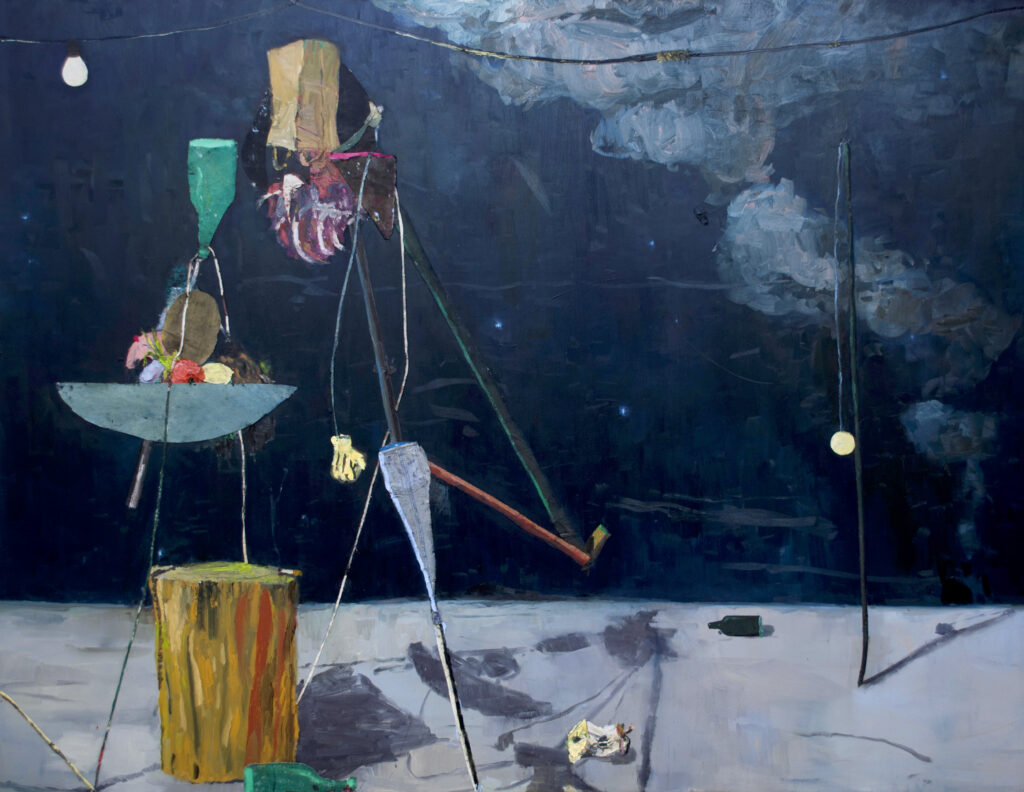
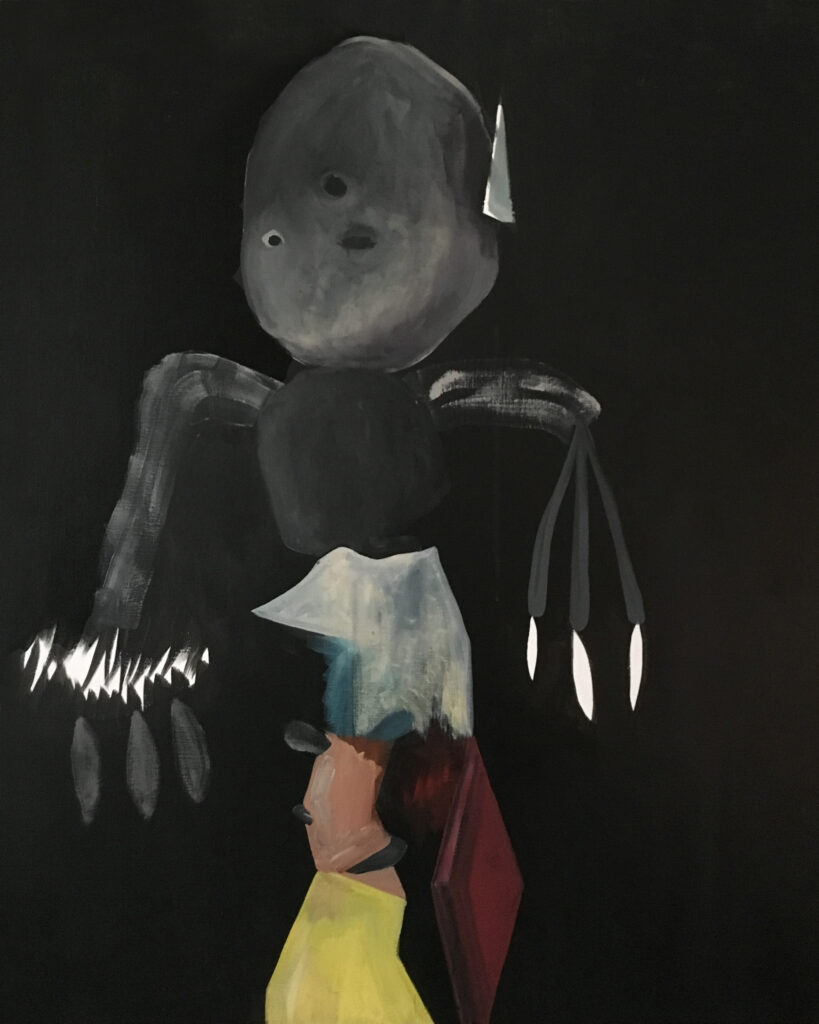
The paintings of Fritz Bornstück invite us to take a solitary walk in a sleepy or locked-down city. The artist works on the notion of dorveille, a word inherited from French and dating from the 17th century to designate a state of drowsiness, half asleep or half awake. A practice located between two phases of sleep which has disappeared over time. (In English it was also called “the watch”.) Dorveille promotes a state that is conducive to daydreaming, to meditation, and to existential and memorial introspection. In this sense, the exhibition entitled Sleepwalking plunges us into a state of semi-consciousness, into an uncomfortable in-between: between wakefulness and sleep, between dog and wolf, between the city and the jungle. between the exterior and the interior. The scenes painted by Fritz Bornstück can be seen as the visual and sensory experiences of a sleepwalker, or of a person going through dorveille before going back to sleep. We thus walk in the company of an invisible protagonist through the streets of Berlin, wastelands, construction sites and other third places or non-places of the city.
From precarious objects, scrap materials and waste, Fritz Bornstück creates a portrait of a society where humans are absent. They departed, leaving behind them the traces of their daily lives: a cigarette butt, a can, an Ikea chair, a radio, an apron, an alarm clock. Identifiable objects that the artist chooses with care. Their presence generates echoes and stimulates our memories. Fritz Bornstück works on the sensitive dimension of a collective memorial platform through which personal projections can occur. So objects are the main protagonists of the paintings: a birthday candle planted in the bun of a burger, a computer tower, a metal bucket, a wooden jukebox, a watch. If the human figure is absent in its physical representation, the combinations of objects (whole and fragmented) form human portraits. The objects and animals personify humanity. We meet a rat who, near a fire, is roasting a marshmallow. The artist also paints turnips with faces with threatening expressions. One of them is smoking a cigarette. Fritz Bornstück thus plays with the layers of reality by alternating science fiction, dreams and social realities.
In the atmosphere of a nocturnal squat, the artist creates “junk spaces” where the artifacts of our past and present existences lie. Concrete meets vegetation, while animals populate the piles of garbage. It is in no way a dystopian still life because, as the artist points out: life is omnipresent. The artist specifies that “human absence gives space to non-human things and beings”. From spiders to owls, tits, snails and hares, animal life unfolds across the paintings. Likewise, trees and saxifrages co-evolve with human ruins to form a recurring landscape. A living perspective that the artist also manifests through his way of painting: quickly, leaving traces of his different passages on the canvas, brutal passages which form layers, roughness and textures. “My painting is not flat, it is not an image without thickness.” Although he paints quickly, Fritz Bornstück speaks of a long period of fermentation during which he returns to his work several times. The density of gestures and representation generates contrary movements, a vibration and a form of toxicity in line with the post-human universe that he strives to depict.
Julie Crenn is an art critic (AICA) and independent curator. Since 2018, she has curated the program at Transpalette - Centre d'art contemporain de Bourges and is artistic advisor for the Atelier A - Arte Creative program.