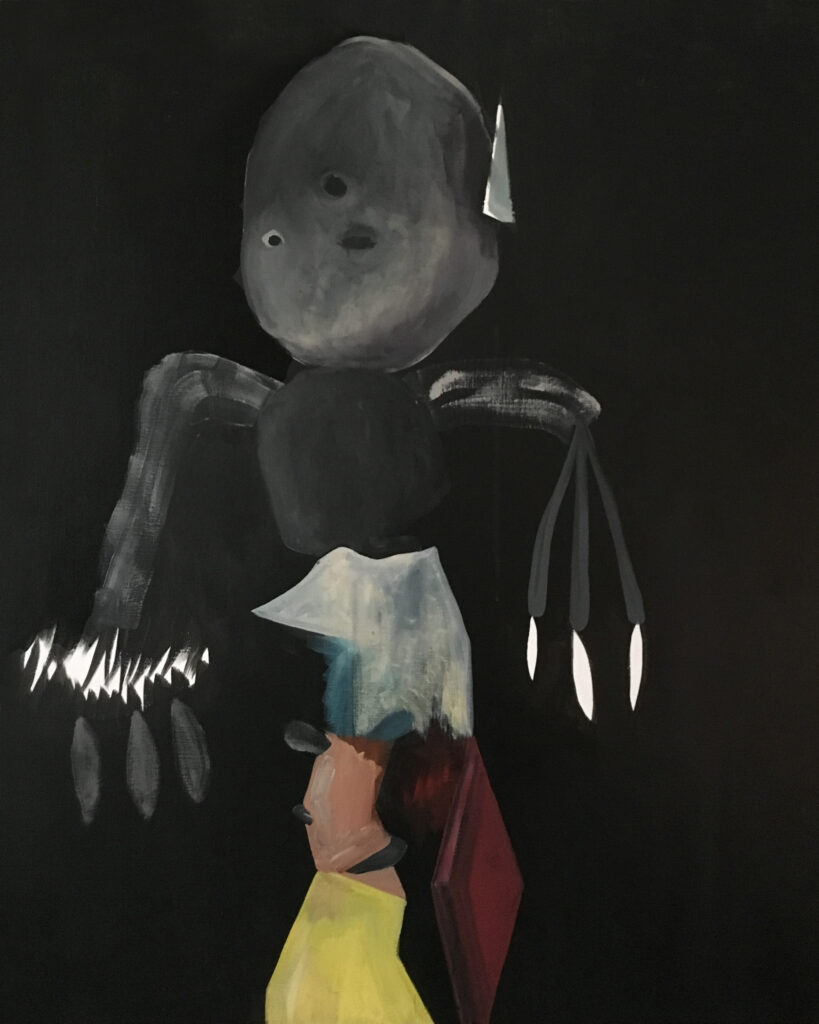
Magnetic spaces by Fritz Bornstück
By Anne Malherbe
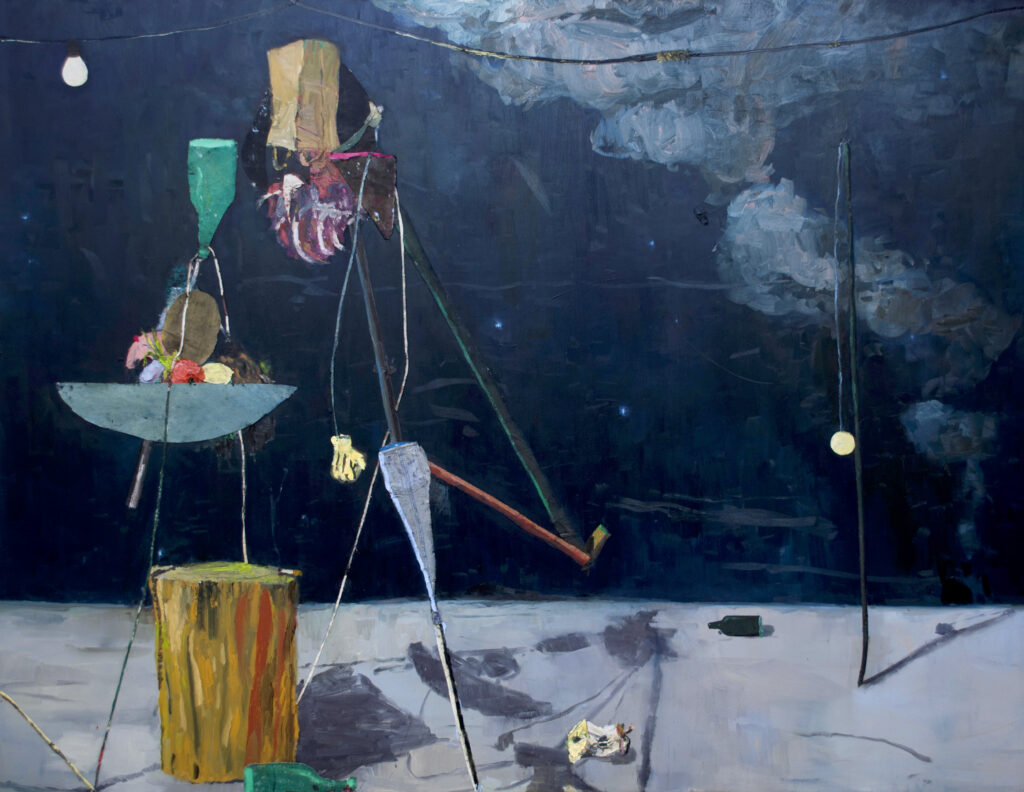
Fritz Bornstück paints still lifes – arrangements of precarious objects, set in rooms bathed in an unnatural light, or in barren landscapes. And yet it is difficult to assimilate these arrangements with our common conception of still lifes as compositions of magnified, shining, alluring artefacts. Here, on the contrary, we are looking at unattractive objects, bits and pieces, debris and detritus – heaps of rubbish left by the side of the road after someone moved homes, traces of a makeshift dwelling in an outdoor setting, the remains of life in an abandoned house.
These seemingly banal things (a wobbly chair, an empty bottle, a broken refrigerator) are treated with special attention by the artist, forming an iconographic vocabulary that serves as the starting point for his paintings. But they are not alone in playing this role. There are also the small objects that the artist happens upon while painting (cigarette butts, old chewing gums). And there are memories, personal encounters with places such as the Auberge des Mésanges, which lends its name to one of the works. These sources (obsessions, memories, all and sundry) act like magnets on each other, forming a forceful centre of attraction from which the painting develops.
And yet it would be wrong to see these paintings merely as snapshots. On the contrary, they are the result of a permanent process, both in terms of their realisation and as regards the specific engagement they require of viewers.
In Bornstück’s paintings, the space is built from a few basic elements, as epitomised by an interior composed of a two-tone tiling, bare walls, an open window, which acts as a matrix. Indeed, this interior space reappears from one composition to the next with slight variations. Then begins the adventurous part, as the painter composes a scene of fragile elements whose balance is permanently threatened. Lianas, a crutch, a ball, an electric cable and an old umbrella have adjusted to each other, and despite the surprising nature of their arrangement each seem to have found their preferred spot. These impossibilities work because the space of the painting has decided so.
Space in Bornstück’s painting seems magnetic. It is a ‘magnetic field’ that attracts whatever comes near it, a string of multiple elements whose confrontation produces a strange, unstable and often humorous or even grotesque result.
Hidden references to the history of art (for instance, the mattress from Jeff Wall’s seminal piece Destroyed Room) are superimposed on motifs borrowed from reality. Bornstück’s paintings thus create their own reality, whose often thick materiality is a key constituent of the work. Indeed, this painterly matter, enhanced with heterogeneous objects (bottle caps, bits of canvas impregnated with pigment), carries its own irregularities and debris. The painting of Fritz Bornstück is a total world that brings together obsessions, memories, art history and tactile qualities, transcending the boundaries between reality and imagination. And when he embarks on his journey, the artist does not know what will happen until the painting is completed.
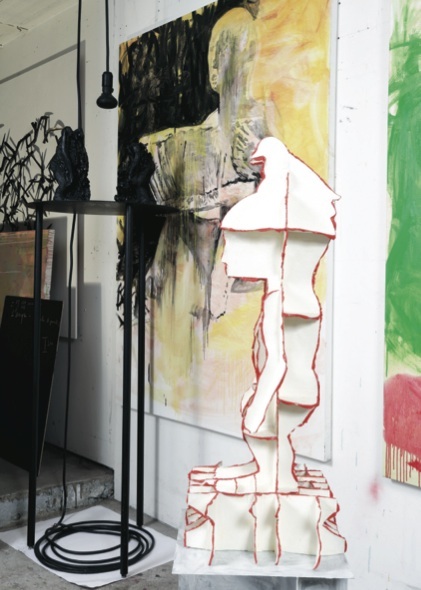
The same applies to his ceramic works, which are created through a risky accumulation of sometimes barely identifiable motifs. They are an extension of his painting – as if the very material of the painting, in its desire to expand, had simply left the canvas.
Bornstück’s series of small paintings focuses on the encounter between nature and human artefacts, a recurring concern in his work. Appearing in a scraggy natural landscape, the motifs are imbued with black humour (a bird with a cigarette in its beak, a cigar stuck in a cup of ice) and shown in obsessive close-ups (a mysteriously switched-on microwave oven, a bottle of detergent thrown into a pond). Beyond the ecological underpinning, what matters first of all is the creation of a place that is cemented by the pictorial matter, for it is this matter that binds together all the contradictions. This painting therefore comes ‘after’: after the history of painting, to which it makes numerous references; after the event during which these places and objects were abandoned; after the human interventions that have terminally damaged nature. It is a kind of painting that brings together that which is scattered and brings back to life that which is dead.
This world is sometimes crossed by a strange character, who is himself assembled from random scraps. A wandering figure with a twisted demeanour, he seems to be searching for his way in this new world without place or time. Maybe he represents the painter, or even the spectator, with whose gaze these paintings ceaselessly play.
FRITZ BORNSTÜCK
Born 1982 in Germany. Lives and works in Berlin, Germany. In the still lifes of Fritz Bornstück, found objects are given a new lease of life. By reusing and repurposing the waste (debris) of popular culture, the artist practices what he calls ‘cultural recycling’. Bornstück is an explorer. His materials draw on a wide range of sources: film noir, found footage, his own environment, his private waste. Bornstück’s works can be found in the collection of the Arken Museum in Copenhagen, the Hildebrand Collection in Leipzig, the Lützow Collection in Berlin, the Paschertz Collection (shown at Museum Heylshof in Worms, Germany) and the SØR Rusche Collection in Berlin and Cologne.