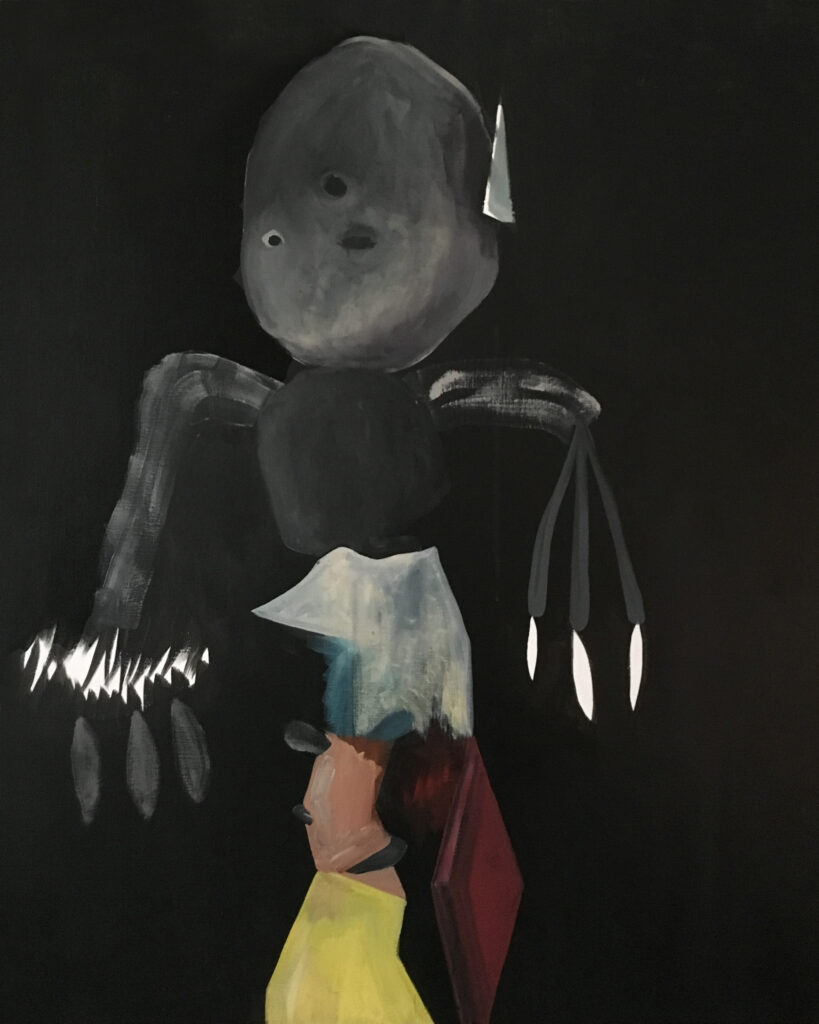
After a Master 2 in Aesthetics and Sociology of Culture (specializing in exhibition arts and scenography) at the Université Paul Verlaine in Metz and a DNSEP Art at the École supérieure des Arts Décoratifs in Strasbourg, Gretel Weyer, who lives and works in Strasbourg, is developing a ceramic practice that transforms simple, everyday objects into fantastical situations that trigger the imagination. Her work hybridizes literary objects, pictorial representation schemes and the grammar of cinema. Derrière le rideau is her third solo show at the gallery.
As part of her residency at Le Cube in Valaurie, Gretel Weyer creates a poetic dialogue between the old and the new, the standard and the unique, the figurative and the marvelous, using traditional models and porcelain. Using casts selected from the Maison Revol collection in Saint-Uze, she brings manufactured objects to life by hijacking their use and motif, transforming them into extraordinary works, interweaving mineral, plant and animal worlds. [...]
What is the content of your residency project?
My intention was to start with shapes from a Drôme pottery tradition, reproduce existing templates and add my own artistic language. [...]
The residency at Le Cube is an opportunity to reactivate this project based on the question of the model and the use of old molds, but to divert their use and alter their form. [...]
How did you go about choosing the molds and making the transition from functional object to artistic creation?
I began by making an inventory of the shapes, classifying them and then selecting fifteen or so molds for their interesting function or motif. I chose shapes on which I can intervene freely, divert the use of the objects, make them unique when they belong to series, transform a traditional production into a contemporary artistic work. Like Georges Perec, I draw on reality and everyday experience, observing the «infra-ordinary», the usual, which I transform into extraordinary, timeless forms through a play of associations, staging, pictorial, literary and symbolic references...
The snails I'm introducing into the funeral urn (ill. 1) come from the Revol collection, and allude to the presence of numerous snails around the Valaurie workshop, as well as to the symbols of resurrection, the spiral...
I'm also interested in the idea of a shape emerging from a mass, like the hare's head that emerges from the lid of a terrine, or the lion's head - the very motif of the tureen - that emerges from the bottom of the tureen. [...]
For me, these figures recall the iconography of the head placed on a tray or the shroud enveloping a body.
by Caravaggio in the paintings Salome with the head of St. John the Baptist, David holding the head of Goliath and The Entombment.
Among the other molds I'm using, I'm working on this funerary pot whose scale motif - already part of my vocabulary
- unfolds and becomes a tablecloth or garment. (ill. 2)
Your creations often draw on literary, mythological or religious sources... and are built on associations of images.
How do you use these images, and do they influence the titles of your pieces?
I draw on these different sources and also draw on cinematic references, such as Frank Beauvais's experimental documentary Ne croyez surtout pas que je hurle, in which he spent six months in isolation watching over four hundred films from all countries and all years.
poetic digression. [...]
This idea of narrative is reflected in the creation of a piece that can refer to several references, such as the Teapot with Rabbit (ill. 3), which is reminiscent of Alice in Wonderland; I was thinking more of Albrecht Durer's drawing The Hare, and the hairy cup is a reference to Meret Oppenheim and her sculpture Le Déjeuner en fourrure.
[…]
How do you see the exhibition that will take place in September at the Maison de la Tour in Valaurie following your residency?
My idea is to re-enact an interior while shifting my approach in a surrealist spirit, to intervene in an ordinary place and introduce the extraordinary. I use salvaged furniture bought on the spot, on which I intervene and compose an ensemble with the shapes I create. For example, I started with a wooden and marble saddle on three legs; I removed the marble plate and replaced the piece of wood holding the legs with a convex mirror. In reference to the lark's mirror, birds will circle it. (ill. 4) A seductive but deceptive object inspired by Jeanne de Flandreysy's collection of lark mirrors on display on the second floor of the Palais du Roure in Avignon. However, other pieces presented on furniture may exist on their own.
Extract from QUI+EST's interview with Gretel Weyer, July 26, 2023.
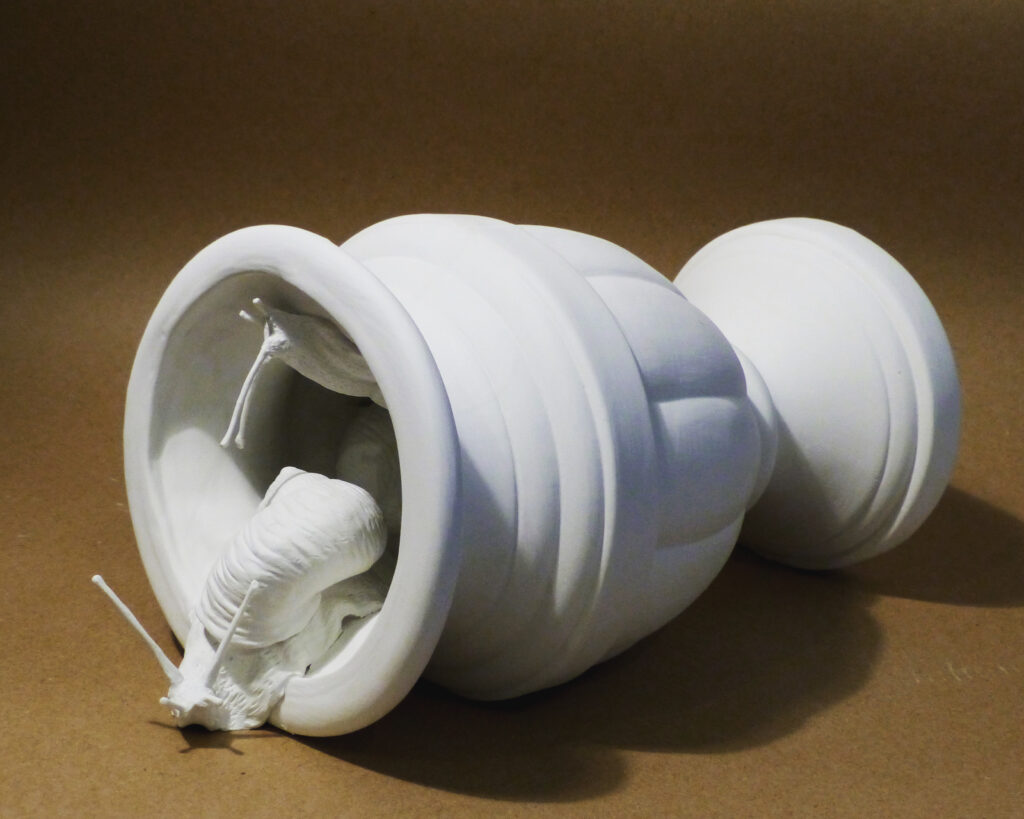
(ill. 1)
Snail urn
2023
Porcelain
30 x 17 x 18 cm
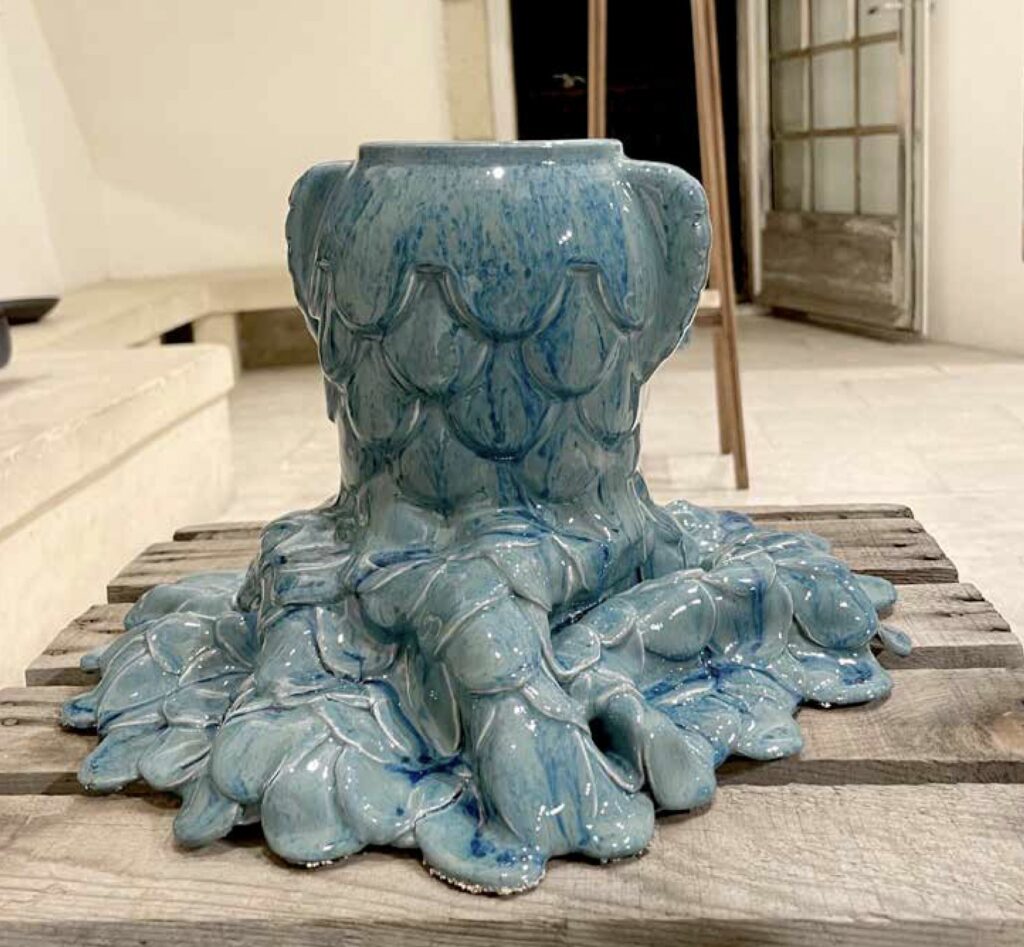
(ill. 2)
Vase
2023
Enameled porcelain
24 x 35 cm
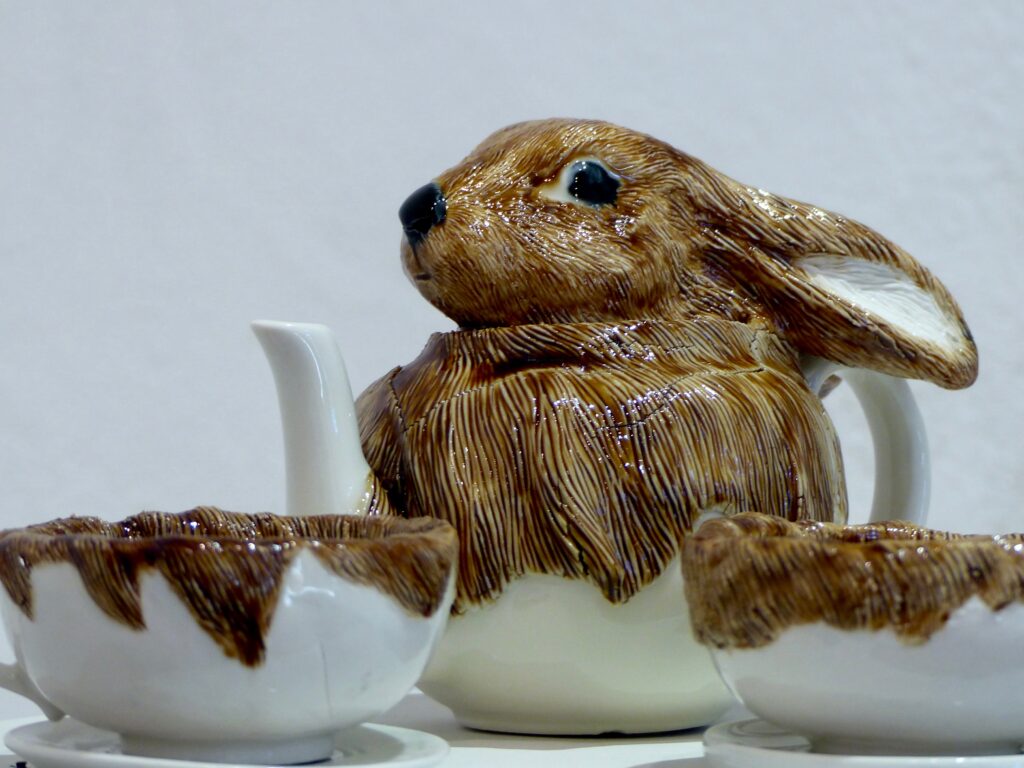
(ill. 3)
Hare teapot
2023
Enameled porcelain
Variable dimensions
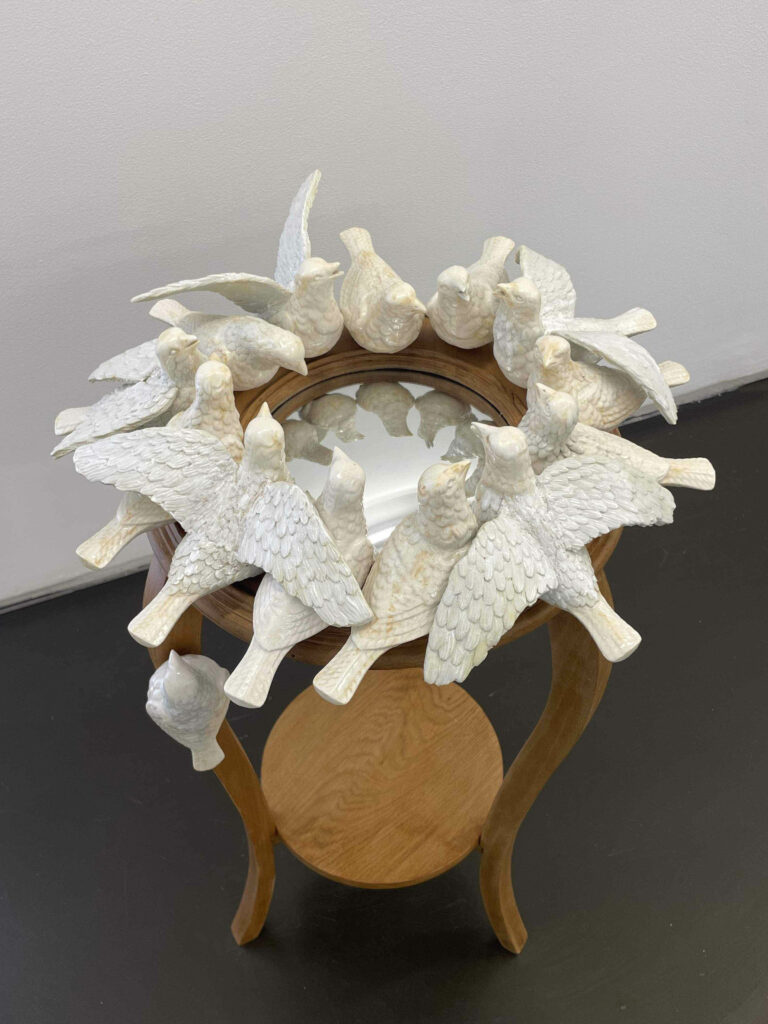
(ill. 4)
Lark mirror
2023
Glazed porcelain, wood and mirror
72 x 39 cm