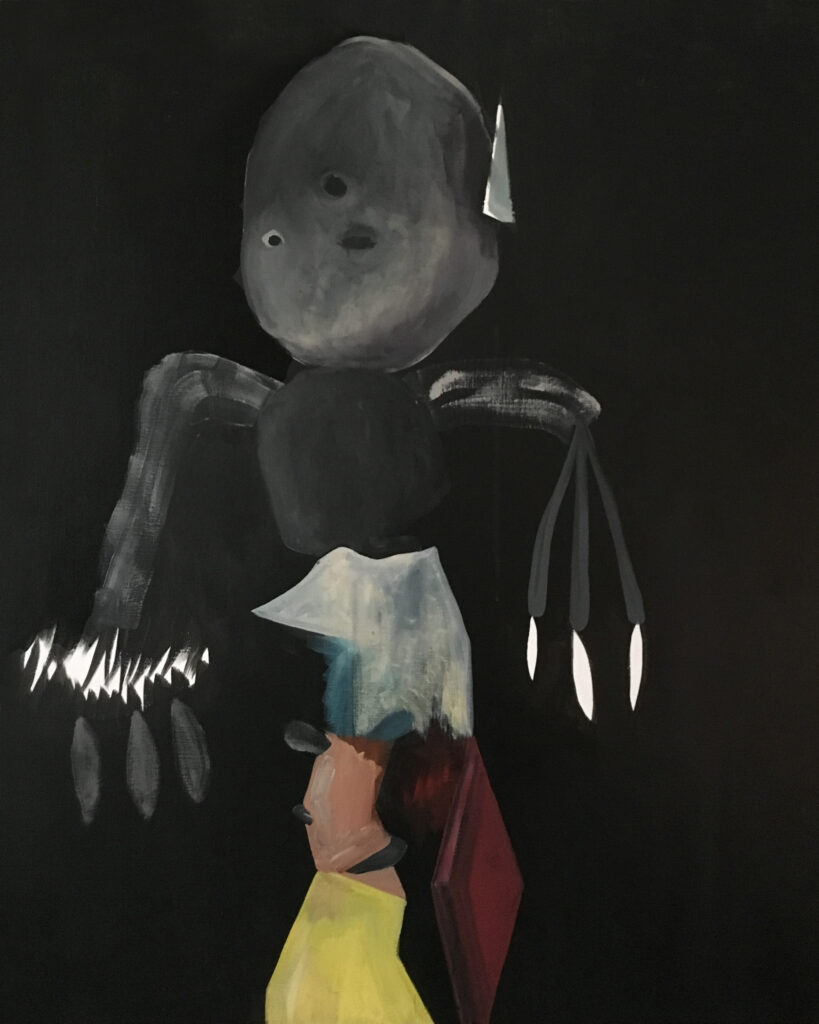
The pathfinders [Translator’s note: Passeur , in French, can mean a ferryman or boatman, a smuggler and also someone who is a transmitter of knowledge and culture from one era to another].
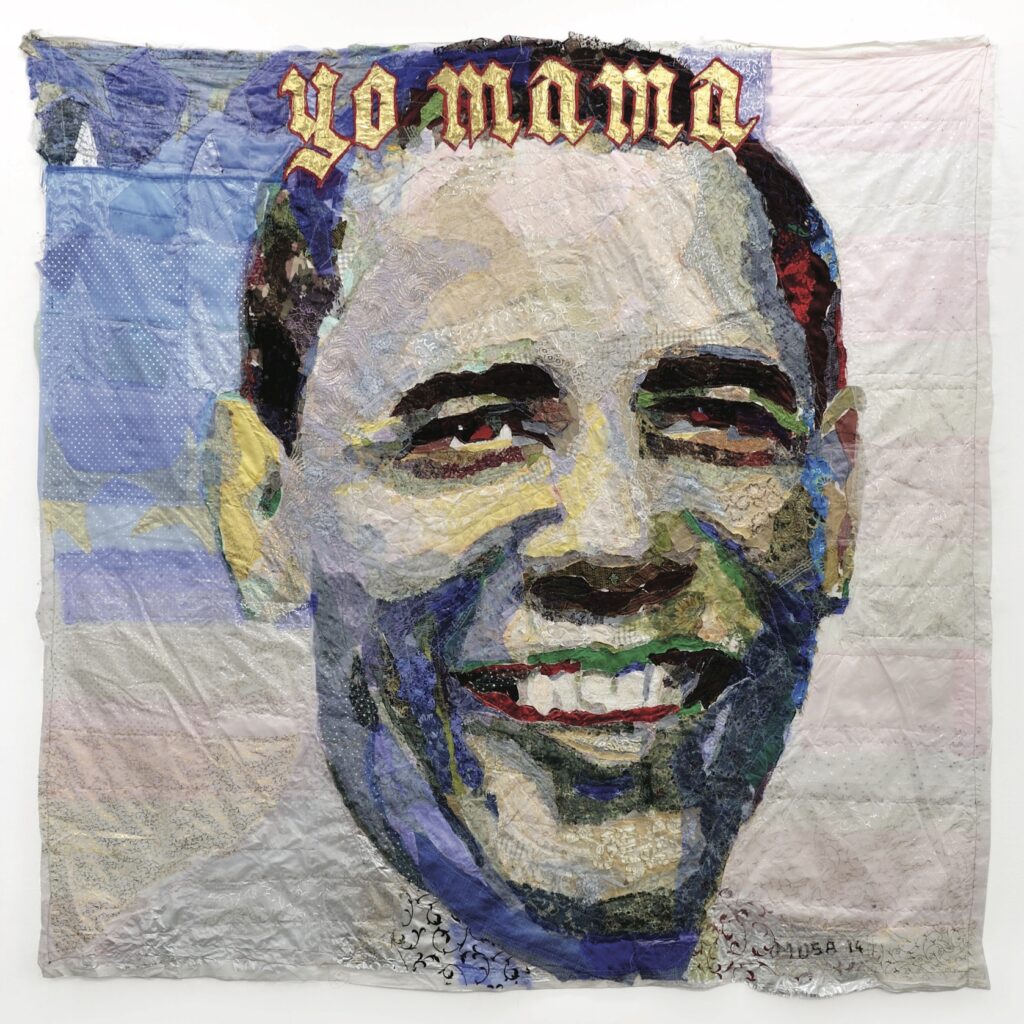
Hassan Musa does not hate irony and his encyclopaedic knowledge of Western art has allowed him to create a playground of infinite variations.
His view of the works he revisits is nourished by a distancing of time and space. A symbolic distortion that reverses the burden of proof, as we would say in law. Delacroix, Titian, Caravaggio and Vermeer are summoned to the witness stand, and suddenly find themselves transported into a timeliness and contemporaneity of which they were perhaps unaware, even though they were each, in their own way, revolutionaries. And it is perhaps this idea of revolution, in the rotational sense, that the artist discreetly introduces, the notion of eternal return so dear to Nietzsche. The very title of this series, Le passeur tranquille, contains a polysemy that explores both internal and external avenues. As far as our times are concerned, Musa insists on the human flows that some have decided are problematic. He manages, while inscribing very contemporary issues in his work, to make those winks that come from historical hindsight.
Are the myths of then so different from the myths of now, and above all, who could this mysterious smuggler be, and where does he get his peace of mind? Immigration, let's face it, needs smugglers. These shadows who operate in the shadows and charter floating tombs. There are official smugglers, international organizations and states. The most famous smuggler I can think of had no easy task. But then, isn't that the fate of all smugglers? Charon had to plug his ears to keep from being moved by the lamentations of those he would, once across the River Styx, deliver to the
gates of hell. But let's get back to the artist who, omnipresent in his project, speaks to us of other forms of passage. Hassan Musa doesn't transport humans, but spaces and temporalities. A magician and alchemist, he takes us on a journey through deliberately anachronistic and visionary settings, where yellow jackets and lightning, Lampedusa and Batman, wordplay and visual games transform the contemporary world into a trompe-l'œil revealing all our hauntings, hidden vices and unacknowledged fears. The ferryman, in this instance, could just as easily be seen as
a pathfinder, in the original sense of the word: one who shows the way.
The smuggler is also the one who ensures a certain continuity and is concerned with future generations, with the memory of women and men who have lived; the smuggler is a link. And it should come as no surprise that Musa is passionate about one of the great "passeuses" of the twentieth century, Josephine Baker. Despite the untimely and somewhat belated celebrations, who among the young girls and boys of the twenty-first century really knows who Josephine was? Contemporary memories
are cluttered with epinal images: the dancer with the banana belt, the muse of the bal nègre, the queen of Music-Hall. But who knows what a Resistance fighter Josephine was? I'm not referring here to her role in the Second World War, or to other facts such as her participation in the fight for desegregation in the terrible «50s and »60s in the USA. I'm talking about a radical ontological resistance that enabled her to thwart all preconceived ideas and clichés and, whatever the circumstances, to always be herself, moving from one world to another without worrying about physical or moral boundaries. And at a time when some evil apostles would like to force citizens to renounce a part of themselves to prove their adherence to the culture that welcomes them, she reminds us of the two loves she proclaimed loud and clear: "my country and Paris". She would probably be prosecuted today for promoting communitarianism.
It would be stupid (but we are never immune to this highly contagious disease) to imagine that Musa used a passing news item to get interested in the girl from St. Louis. For years, and this corresponds perfectly to his artistic quest, this alchemist has been interested in the life of the lady. About the way she was perceived, the misunderstandings her life has raised and the way she presented herself to the world. There are passeurs , as we have seen, who exploit all the misfortunes of the world to carry out their culpable industry and others, on the contrary, who know how to do nothing other than reach out their hand to those who will come. James Baldwin, another great passeur of our time, wrote, when the authorities of a racist America arrested Angela Davis, that this story concerns us all : "For, if they take you in the morning, they will be coming for us that night".
Musa tells us that all the stories in the world are interdependent because they are made by humans. And nothing human should be foreign to us. This is what the peaceful passeurs all around the world remind us.
Simon Njami
Simon Njami is a writer, curator, essayist and art critic. He specializes in contemporary art and photography in Africa. His books include Africa Remix, The Divine Comedy, several editions of DAK'ART La Biennale de Dakar and Rencontres Photographiques de Bamako.