Many years ago, photographs adorned the foyer of movie theatres when a film was being shown. Intended to attract the attention of a passer-by and to arouse the desire to go in and watch the film with its evocative name – Gorky Park, The Great Jewel Robber, Junior Miss or again Summer and Smoke – they were regularly replaced by others very similar to those that were there previously. The decor, the lighting, the framing of the shot, the position of the actors; everything evokes in a single image the atmosphere of the film and the proposed story and if today they have the scent of an outdated time, it's that the actors as well as the sets recall a distant cinema.
Some photographs show wide shots, scenes in which we see many people gathered together; in others, only a couple is in the foreground. Face to face, a man and a woman close together look at each other, frozen in the moment just before they take each other in their arms, before they kiss.
The visitor to the foyer has no other solution than to mentally complete the stopped scene and to project themself into the story suggested by the row of images.
John Stezaker brings out of anonymity or the forgotten past these portraits of men and women who brought stories to life.
On a first photograph, he cuts out and removes the couple in the foreground of one of these “foyer” photographs, leaving an empty trace on the paper. And this void, which removes the heroes of the film, opens the photograph to all gazes because around this cut-out made within the image, the environment in which the actors moved still appears and one can easily recognise the places; a garden, a cloakroom, a plush interior or a dimly lit wall...
The absence of the silhouettes creates a questioning that is all the more troubling because the actors and actresses – beautiful, young, in love – who have disappeared from the field of vision now exist in the viewer's imagination. It is up to him to mentally paint their features, to give the evaporated couple a face and clothes which he assumes to be elegant, a refined look, a stylish haircut or a hat, a way of looking at each other that signifies love or hate, respect or indifference, anger or joy.
This is all the more true since these are – let us not forget – ephemeral images, made for a specific purpose, designed to attract the aforementioned passer-by who is available but who hesitates and procrastinates, inclined to prefer this or that, depending on a fleeting mood, who takes the time to scrutinise the photographs one after the other and designed to instil a desire or a secret intention through a detail that captures his attention. His eyes, which grasp an object, invite him to dream of a fiction known only to him.
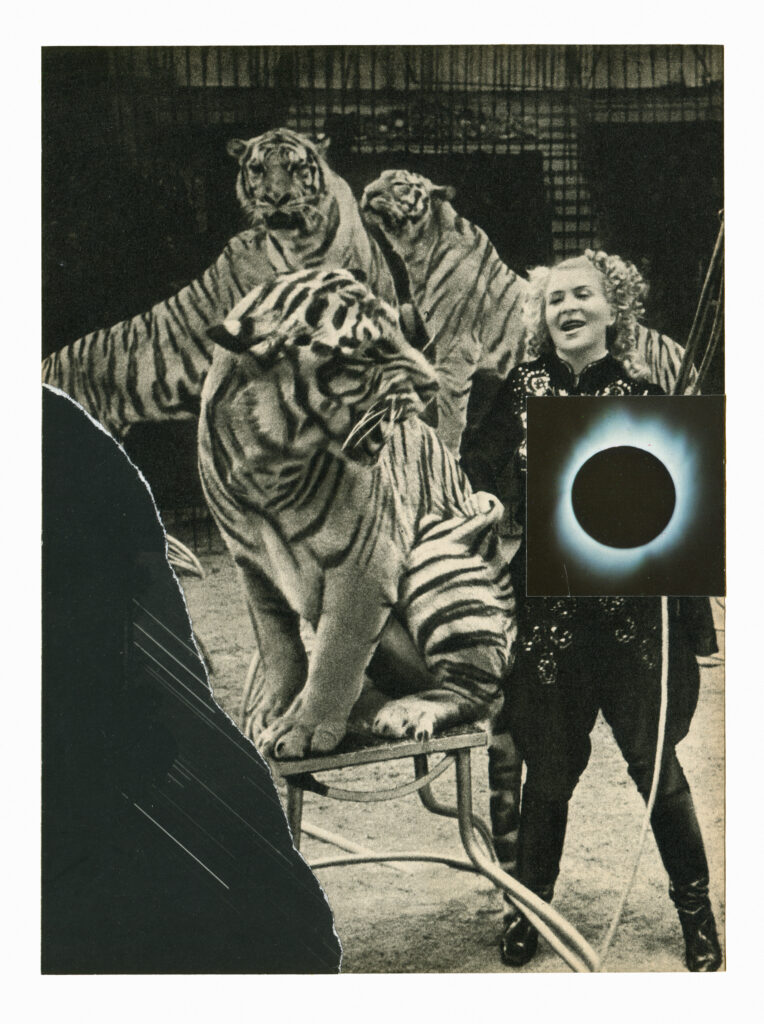
John Stezaker adds another photograph to the background of the first cut-out, another scene which may or may not belong to the same film, which fills the void of the silhouettes and overflows the frame: a restaurant, an assembly, a living room with people busy doing various tasks, seeming to converse, strangers to the scene in the foreground.
Or, as in the past, in cinemas we watched actors evolve in a landscape, an interior scene, and furniture, which was probably only a fragile decor; one of those cardboard and canvas decors, held upright with weights and supports placed at the back of the structure, and which are changed rapidly according to the successive stages of the action.
The characters in these collages are not on the same scale and not in the same situation, as in fairy tales, where giants suddenly appear and disappear, vanish and go who knows where, into a foreign world and rub shoulders with tiny beings.
Or, as in the old days, in movie theatres we watched the actors evolve in a landscape, an interior scene, a piece of furniture, which was undoubtedly only a fragile set; one of those cardboard and canvas sets, held upright by weights and crutches placed at the back of the structure, changed rapidly according to the successive phases of the action.
Or, as in the old days, in movie theatres we watched the actors evolve in a landscape, an interior scene, a piece of furniture, which was undoubtedly only a fragile set; one of those cardboard and canvas sets, held upright by weights and crutches placed at the back of the structure, changed rapidly according to the successive phases of the action.
In the rapid movement of the film that crossed the room, a beam of light laden with dust revealed these artificial paintings and the actors of a romance for couples holding hands, whispering and embracing.
Thus, the shadow of the decor becomes the shadow of the characters and we adhere to this fascinating world without wishing to sort out the real and the fake because the world is also made up of an addition of various realities.
This is the case with John Stezaker's collages in which the superimposed scenes assemble to form a single one, mixing memories and discoveries in the open windows on the "foyer photographs".
Laurent Busine
UPCOMING 2023
Sussex Landscape - Chalk, Wood and Water, Group show, Pallant House Gallery, Group show, Chichester, UK Gray 60th anniversary exhibition, Group show, Richard Gray Gallery, New York, USA
Solo show, Petzel Gallery, New York, USA
Sols show, Kaufmann Repetto, Milan, Italy
Wörthersee, Wörtersee, Group show, Kunstraum Lakeside, Klagenfurt, Austria
Becoming Landscape, St Moritz Art Film Festival
Piero Tomassoni's show, Group show , with David Tremlet Group show, Prada Foundation, Milan, Italy
SOLO SHOWS (SELECTIONS)
John Stezaker, Fondazione Morra Greco, Naples, Italy (2021)
At the Edge of Pictures: John Stezaker, Works 1975-1990, Luxembourg & Co, London, UK (2020)
John Stezaker, National Portrait Gallery, London (2019)
Lost World, City Gallery Wellington, New Zealand (touring show) (2017-2018)
John Stezaker, Whitworth Gallery, Manchester, UK
Aftermath, York Art Gallery, UK (2017)
Film Works, De La Warr Pavilion, Bexhill-on-Sea, UK; Collages, Fotomuseum Nederlands, Rotterdam, JThe Netherlands (2015)
John Stezaker, Centre de la Photographie Genève, Switzerland
John Stezaker: Working from the Collection
Les Rencontres Arles Photographie, Arles, France
John Stezaker: One on One, Tel Aviv Museum of Art, Israel (2013)
Marriage, Haggerty Museum of Art, Milwaukee, USA
John Stezaker, The Whitechapel Gallery, London, touring to MUDAM, Luxembourg and Kemper Art Museum, St. Louis, USA (2011-2012)
Lost Images, Kunstverein Freiburg, Germany (2010)
AWARDS
Stezaker was awarded the Deutsche Börse Photography Prize in 2012. His work has been the focus of a number of publications,
including John Stezaker: At the Edge of Pictures, Yuval Etgar, Koenig Books, London (2020); John Stezaker: Love, London:
Ridinghouse, published on the occasion of Love at The Approach, London (2019); John Stezaker: Lost World, London: Ridinghouse,
published on the occasion of Lost World, touring exhibition in various Australia and New Zealand locations (2018) and John Stezaker,
London: Ridinghouse, in association with Whitechapel Gallery, Mudam Luxembourg, and Mildred Lane Kemper Art Museum (2010).
COLLECTIONS Stezaker’s work is in collections worldwide, including: Art Gallery of New South Wales, Sydney, Australia, Arts Council England, UK; Birmingham Museums Trust, UK; British Council Collection, UK; Ellipse Foundation Contemporary Art Collection, Cascais, Portugal; FRAC Ile- de- France/ Le Plateau, Paris, France; Frans Hals Museum, Haarlem, Netherlands; Los Angeles County Museum of Art, Los Angeles, USA; MoMA, New York, USA; MUDAM Collection, Luxembourg; RISD Museum of Art, Providence, USA; The Rubell Family Collection, Miami, USA; Sammlung Verbund, Vienna, Austria; Seattle Art Museum,Washington, USA; Stedelijk Museum, Amsterdam, NetherlandsTate Collection London ,UK; The University of Warwick Art Collection, Coventry, UK; The York Museum Trust, York, UK; Whitworth Art Gallery, Manchester, UK