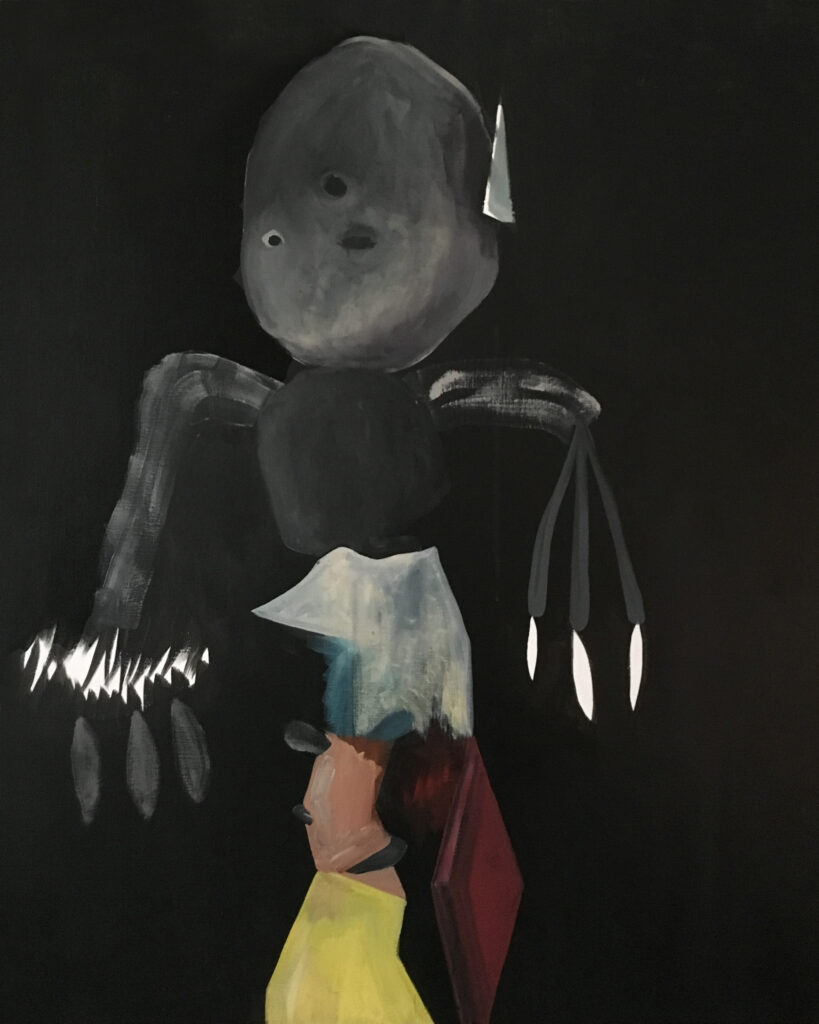
Horseshoe crabs are marine creatures whose morphology – a body protected by an articulated exoskeleton and blue blood due to the presence of copper – has been unchanged for hundreds of millions of years. Traditionally used for food, fishing bait or as fertilizer, but even more now in the pharmaceutical industry, horseshoe crabs are in sharp decline, while our own survival is weighed against theirs. Their blood cells allow us to detect the presence of bacteria on surgical equipment, in injectable liquids and various medications, which has us with our backs against the wall: risk being inoculated with a deadly substance or – while waiting for a synthetic version to be developed – sacrifice these arthropods, knowing that many of them will die from being bled in the laboratory.
Choosing “Le sang des limules” (The blood of horseshoe crabs) as the title of her exhibition is a way for Myriam Mihindou to invite us to think with her about the current state of the world, in its political, economic and ethical complexity, by resisting what crushes us, by affirming our empathy with the living, and of course, because this has always been the common thread of her artistic approach, by following her in her project of linking art and care.
She still had to invent her tools and weapons – films, photographs, drawings, sculptures and installations – experiment over and over with constraint and liberation, overcome her fears, establish healing and self-healing rituals, explore letting go and reactivating memories, restore the power of the feminine, inscribe the ritual in the material itself, or shake up the language to oppose disaster with something good. Inseparable from this multifaceted and hyper-coherent production, her transperformances are strong moments of experience and sharing, with no dividing line between the spiritual and the political, the intimate and the common.
The series Le Patron (2024) is made up of sheets of tracing paper and tissue paper assembled with needles, combining drawings, collages and words embroidered with copper thread. In sewing, “patron” translates as “pattern”; a guide, a framework and a method. In art, we could see it, with Gilles Deleuze, as a diagram, a matrix initiating a creative process. Here, as is often the case in Myriam Mihindou’s work, the names of the pieces – L’intérieur de ses mains roses (The inside of her pink hands) – image and text in the same poetic enigma.
One of the works bears the words ARIUM NO AB OVO, which refers to the indefinite place of impossible origins, but its title is Nota Bene, like a memento without an object and without a particular address: it is up to each person to know what is important to remember or what to focus on. Others – Le partage des eaux; Flumen, Fluminis (river, watercourse) Commigrare, o, aui, atum (to pass from one place to another, to inhabit); Oceanic carbon – evoke improbable nocturnal landscapes, perhaps before language came to qualify and separate the blue waters and the earth, the blood of horseshoe crabs and the primordial ocean.
Evelyne Toussaint
Contemporary art historian
Emeritus Professor of the University of Toulouse Jean Jaurès