Drunkenness
By Julie Crenn
In linguistics, etymology consists in researching and understanding the roots of a word, but also in revealing the relationship between the sound (enunciation) and the word (signifier). Myriam Mihindou has long experienced this association as a trauma. For several years, the artist has immersed herself in an etymological research that aims to ‘bring to the surface my fleur de sel’1 and to be able to identify things, to overcome boundaries and create images and representations. Since her childhood, she has been fascinated with dictionaries and encyclopedias. Above all, she devoured the medical books collected by her mother when she was a hospital director. By reading and studying anatomical charts, she discovered the human body in all its glory while learning about diseases and germs. It is not surprising, therefore, to see that her new series of sculptures is entitled Amygdales (Tonsils). Made of wood and copper, they take their cue from a dowsing rod, which is here developed into vegetal and organic forms. The series results from an examination of the common medical practice that consists in surgically removing the adenoids. Yet, as the artist explains, tonsils are an essential part of the body, ‘an element of survival that helps us identify, gauge and manage fear’. This would make removing them an authoritarian and violent practice that generates fear and perpetuates confusion. These works, then, are part of a wider reflection that takes a critical look at tools of domination such as medicine and language – the very tools that take part in the colonisation of bodies and modes of thought..
The exhibition was prepared in Meisenthal, a small French town near the German border.
At the heart of this territory of boundaries the artist created a series of new works. Myriam Mihindou tracks the hybridisation of languages, the incongruities and the “disenchantments”. The German language interacts with the French language, the two cultures forming an alliance by way of words. She brings to the fore what she calls ‘the schizophrenia of language’, in which one word can hide another, a binarism that lets meanings overlap and contradict each other. In her effort to undermine the paralysing dualism on which Western societies are founded, Mihindou works with the plasticity of words, both literally and physically. She hybridises opposites by marrying glass and copper – ‘incompatible materials’ that she puts in a relation. We must therefore listen to and read the words to grasp the Creole essence: ‘languages that are visual and restorative’
Myriam Mihindou aims to ‘heal the body by way of the word’. Since 2006, she has been developing a series of collages and embroideries titled Les Langues Secouées (The Shaken Tongues), in which she cuts up words and puts them in relation to each other in order to question them and open them up. At Galerie Maia Muller, the artist presents a performative work that is also based on dictionaries. She has written and drawn straight onto the wall, overcoming the limited format of the page so as to add a physical dimension to her research. ‘The body works to unearth the work and reveal the language. It took time, but now I see.’ She sees and hears ‘the words sing’. The relationship between words and sounds is active, as it creates an ‘overflow’, or ‘awakening’, of intense sensations. ‘All of a sudden, I hear, I see, I can identify things, so in that sense it’s a form of intoxication’. A form of intoxication that gives her the energy and strength to explore the depths of a system built on exclusion and violence. On one of the walls, she is showing ANALPHABÈTE (Illiterate), a word she sees as a ‘nerve centre’. This imposing three- metre-large work makes visible a wound that had been concealed. The artist chose to make it from copper wire, a conductive material, a means of transmission. It’s a material the Dogon in Mali associate with water: ‘water is speech, speech is fertile’.2
Copper resonates with speech, ‘the reactivation of sleeping neurons’. Orality is a tradition, a means of transmitting stories, a skill, or knowledge that is shared without the support of writing. Mihindou translates the violence of the word illiterate with the effect of ‘an atomic bomb’. It stands for a practice of discrediting, for a system in which the dominant literati discriminate against those who are not, in their eyes, in ‘an animal state to wield power’. A way of thinking that ignores a whole wealth of knowledge not transmitted in writing, but by the body, through speech, through materials. It is therefore the artist’s task to take care of the words, of the meaning given to them and the history they convey. By doing so, she participates in a political movement that aims to decolonise language, more specifically the French language. On this issue, Achille Mbembe and Alain Mabanckou have written: ‘We are campaigning for a world-language, a planetary language, a language of what we have in common, a vehicle for dissemination at the intersection of the forces of life and the forces of openness; a language humanity as a whole could use in order to share new and committed words that question our destiny in terms of its commonalities and singularities.’3
1 All quotes from the artist are taken from a conversation conducted on August 13, 2018.
2 GRIAULE, Marcel. Dieu d'eau - Entretiens avec Ogotemmeli . Paris: Fayard, 1966.
3 MBEMBE, Achille; MABANCKOU, Alain. «Plaidoyer pour une langue-monde - Abolir les frontières du français», in Revue du Crieur, n°10, June 2018, p.67.
Myriam Mihindou was born in 1964 in Libreville, Gabon. She lives and works in Paris and abroad.
News - 2018: None of his bones will be broken, Curator: Alicia Knock, Galerie Saint Séverin, Paris / Transmission, Curator: Anne Dopffer & Johanne Lindskog, Musée national Pablo Picasso, Vallauris - Poétique du geste, Curators Sonia Recasens & Maud Cosson, La Graineterie, Houilles, France - 2017: D'un monde à l'autre, Fondation Salomon, Annecy Venice Biennale, Performance, Pavillon Arts & Globalization, Venice, Italy / Afriques Capitales, Curator: Simon Njami, La Villette, Paris / Les ailes de mon père, performance, Curators: Pascale Obolo & Kader Attia, La Colonie, Paris.
Collections in France and abroad :
Fondation Claudine et Jean-Marc Salomon, Collection Abbaye d'Auberive, Collection Sindika Dokolo, Collection Eric Touchaleaume, Musée Léon Dierx, FRAC Alsace, FRAC Réunion, FRAC Poitou-Charentes.
Myriam Mihindou
No bone of his will be broken
February 22 _ April 26, 2018
Myriam Mihindou is a Franco-Gabonese artist who works the body and sculpture in a reciprocal choreography, inhabited by memory as well as by the organic and spiritual energy of places and materials, «unbreakable fragiles»: soap, cotton, wax...
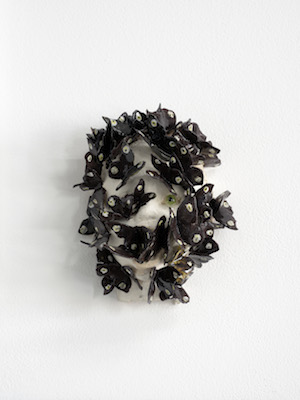
For Galerie Saint-Séverin, she produced a performance based on the Last She-Wolf*, a matrix figure in her work: La Lopa - Myrtle - silk thread - etymologies - hemp - cotton flowers - feather - Paris 2015-2016 (in two parts, the she-wolf's head and cotton base - (the last she-wolf).
Last in the series of nine wolves she has sculpted, she appears as a martyr with her head cut off, but also seems to be offered a possible resurrection. This she-wolf, placed in the showcase as a reliquary, contrasts with the artist's other hanging wolves, haunted by the memory of «strange fruit**». The last she-wolf, placed on its cotton base, is an offering of wounding and healing, paying homage to feminine energy and its regenerative forces, themselves at the heart of the artist's work. This deposition is enveloped by an ex-voto: the gentle psalm of a shaken tongue, waiting to emerge - from the project's title - to polish a time of shaking. The Langues secouées series, also operative in Myriam Mihindou's work, is an attempt at bodily appropriation of etymology, integrating the crossed genealogies, conscious and unconscious, inhabiting our relationship to the word, particularly when it is traversed by the body.
Behind the glass of the showcase, the she-wolf's head preserves the energy of her skeleton: «[she] keeps all her bones, not one of them is broken» (Psalm 34:20). Behind the glass of the showcase, the she-wolf's head preserves the energy of her skeleton: «[she] keeps all her bones, not one of them is broken» (Psalm 34:20).
*The reliquary, which I associate with the figure of the She-wolf, is an important aesthetic figure in the collective imagination of Gabon. It was placed over the bones of our ancestors and represented a lineage, a sacred point of communication between the living and the dead. In my construction of the work on the wolves, a whole process takes place... I start with words chosen over several days, several weeks, they lead me to other words, other formulas, then psalms... and in this interplay of relationships I build up the character of my wolves, I would even say the identity of my wolves - this gesture of meditation, prospecting and patience reveals what I call the aesthetics of the work.« Myriam Mihindou, February 2018
**Southern trees bear strange fruit Blood on the leaves and blood at the root Black bodies swinging in the southern breeze Strange fruit hanging from the poplar trees... Billie Holiday
In my construction of the work on the wolves, a whole process takes place... I start with words chosen over several days, several weeks, they lead me to other words, other formulas, then psalms... and in this interplay of relationships I build up the character of my wolves, I would even say the identity of my wolves this gesture of meditation, prospecting and patience reveals what I call the aesthetics of the work.»
Myriam Mihindou, February 2018