
Acrylic on wood,
156 x 105 cm
Oil on fabric printed on wood,
150 x 170 cm
Ink on textile,
188 x 214 cm
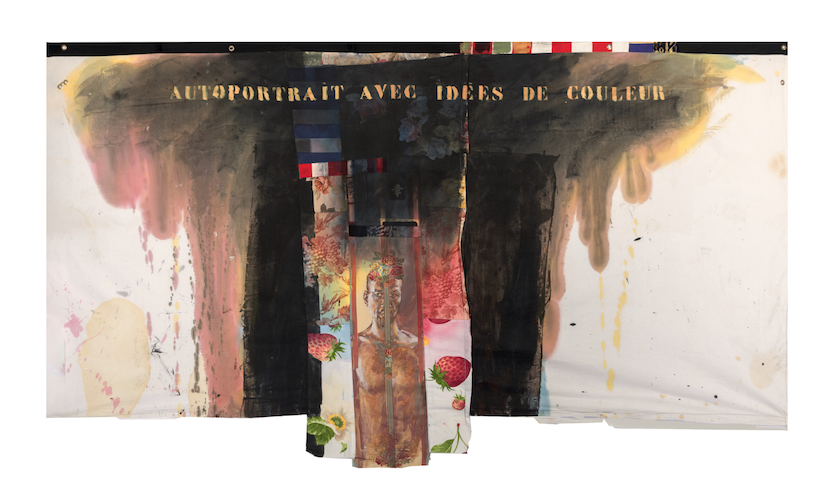
Ink on textile
166 x 287 cm
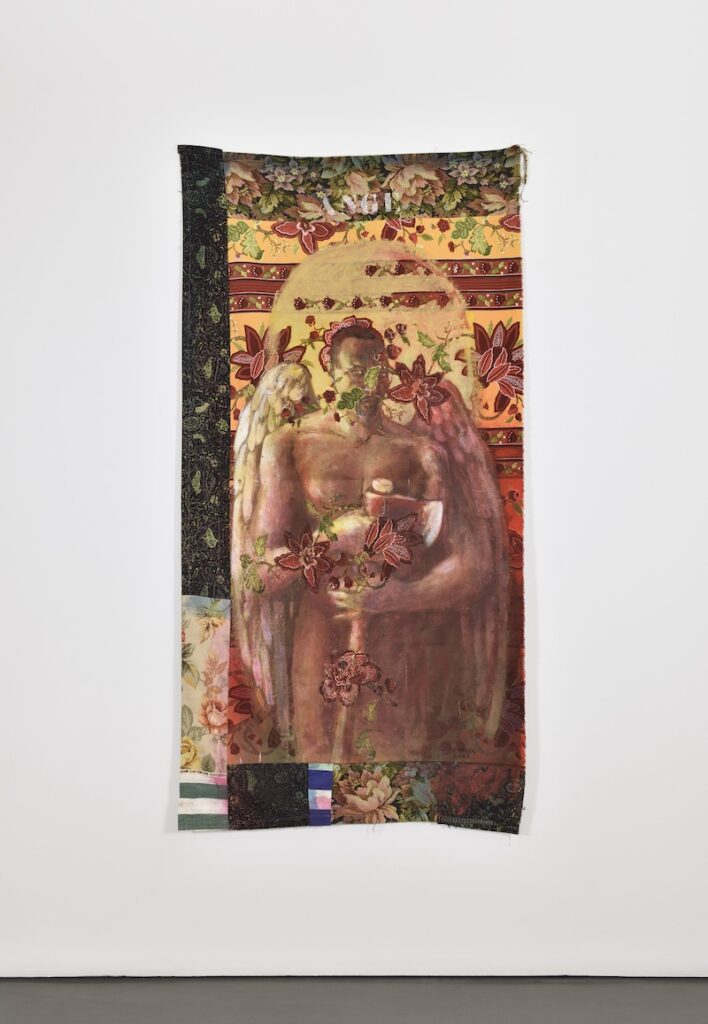
Ink on textile
172 x 86 cm
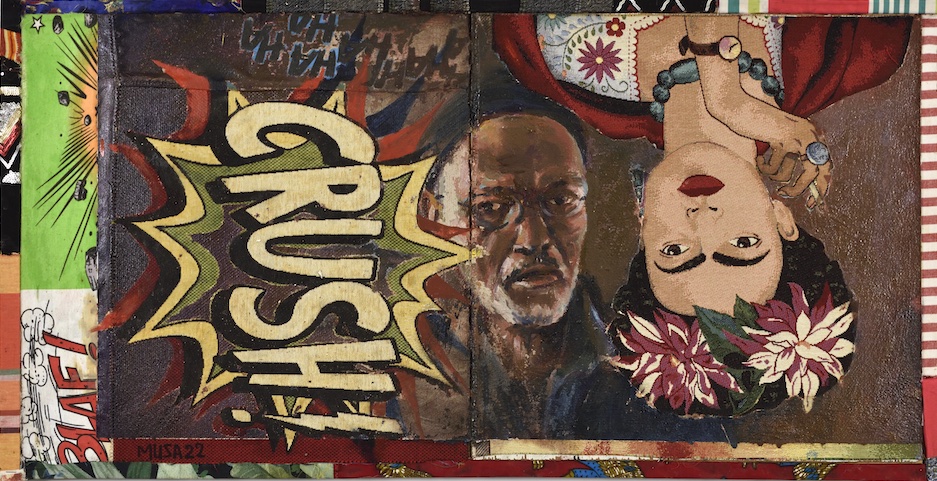
Oil on fabric printed on wood,
52 x 102 cm
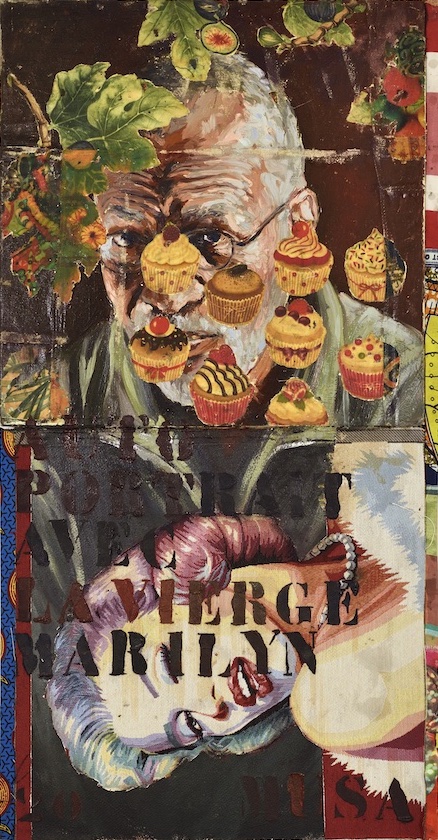
Oil on fabric printed on wood
100 x 52 cm
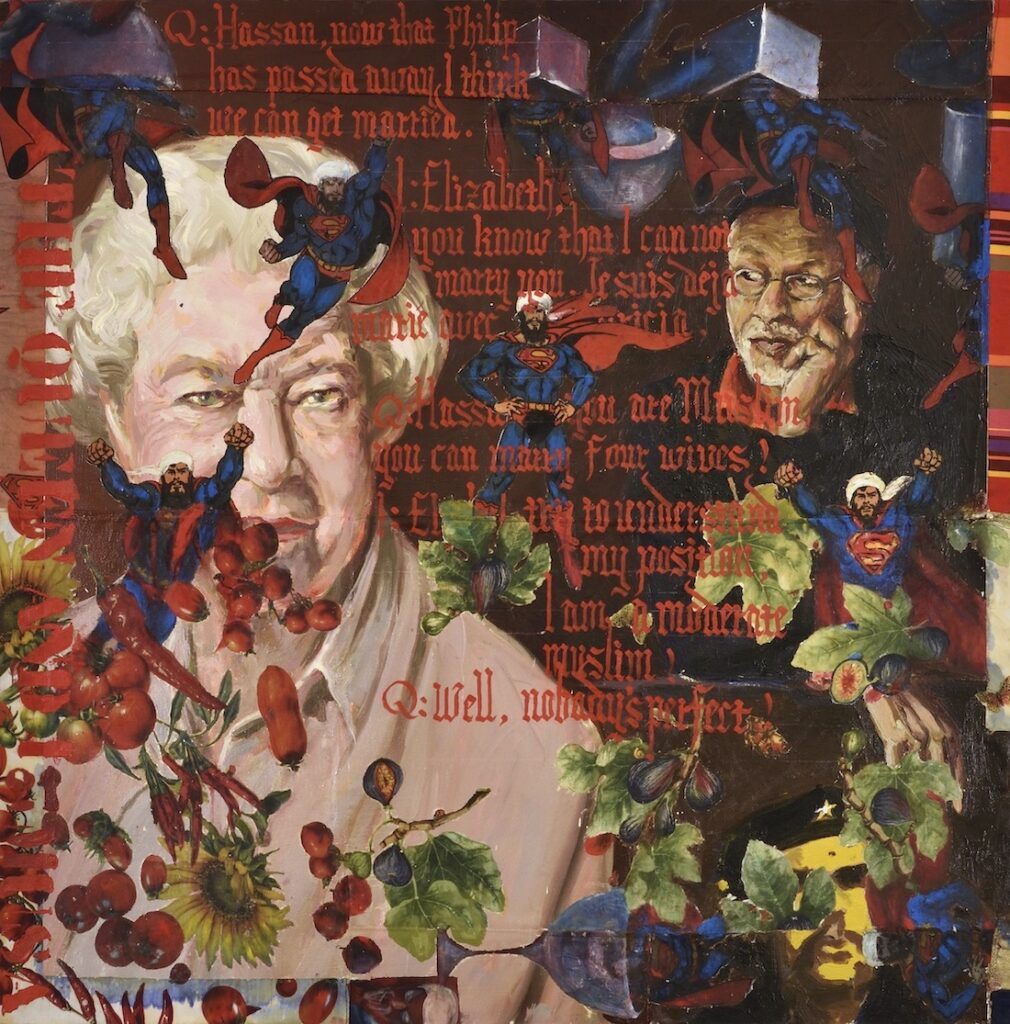
Oil on fabric printed on wood
100 x 100 cm
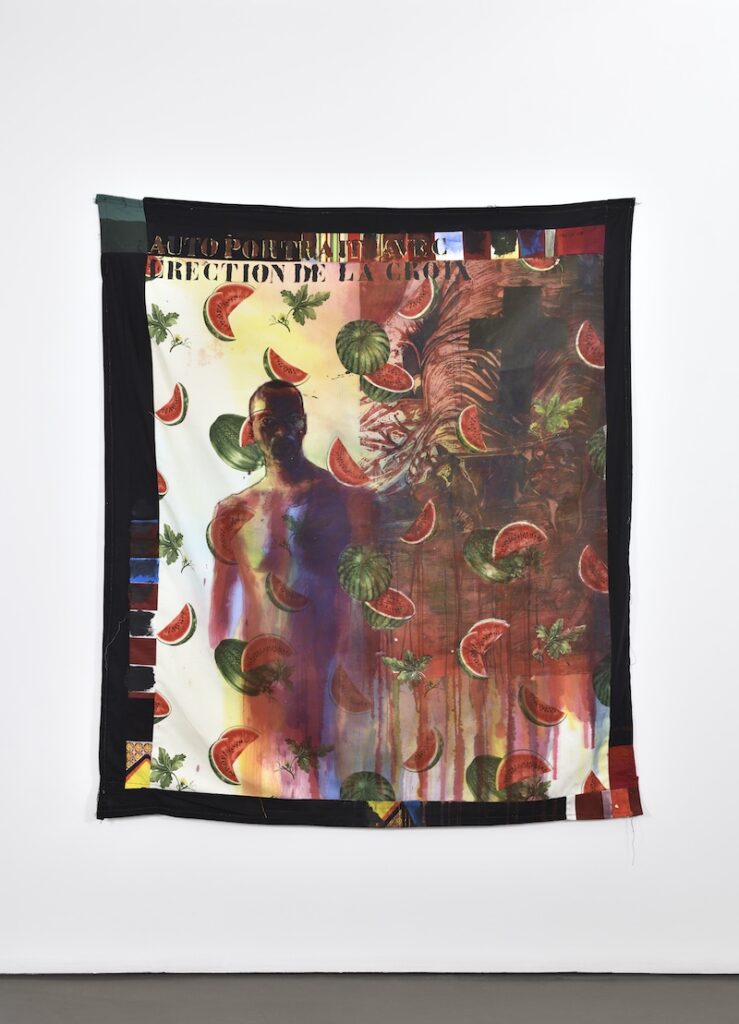
Woodcut and ink on textile,
172 x 146 cm
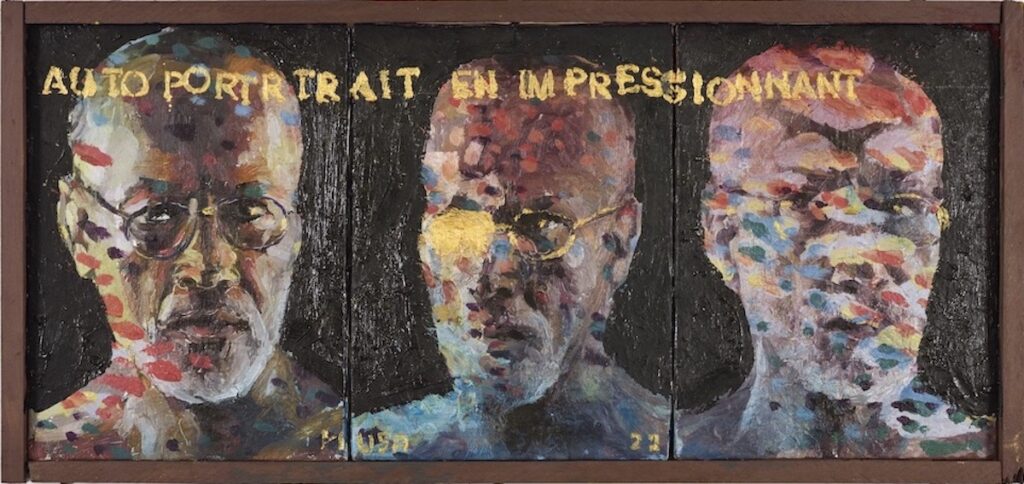
Oil on canvas,
24 x 54 cm
Ink on textile,
146 x 233 cm
In the Western tradition of the self-portrait, painters put into practice something of the singularity of their relationship with the world - Dürer's beauty, Rembrandt's reality, Francis Bacon's naked life, Andy Warhol's surface... - in a long series of stagings of self(s). Hassan Musa, an artist in the age of critical thought and deconstruction, opts for a different way of facing oneself, one that is both intimate and geopolitical.In his self-portraits, as in all his paintings, on wood, printed fabric or canvas, in ink or oil, he lays bare the images and words of a great maelstrom of cultural references, in a kind of intervisuality that he sifts through with his corrosive irony, in a telescoping of heterogeneous elements that a quirky sense of humor holds together. In literature, his assemblages could be described as zeugmes, associating elements belonging to different semantic registers, or as anacoluthe, with discontinuities and anachronisms, or in any case as ellipsis and the implicit. So much for the diagram, which renews the genre.
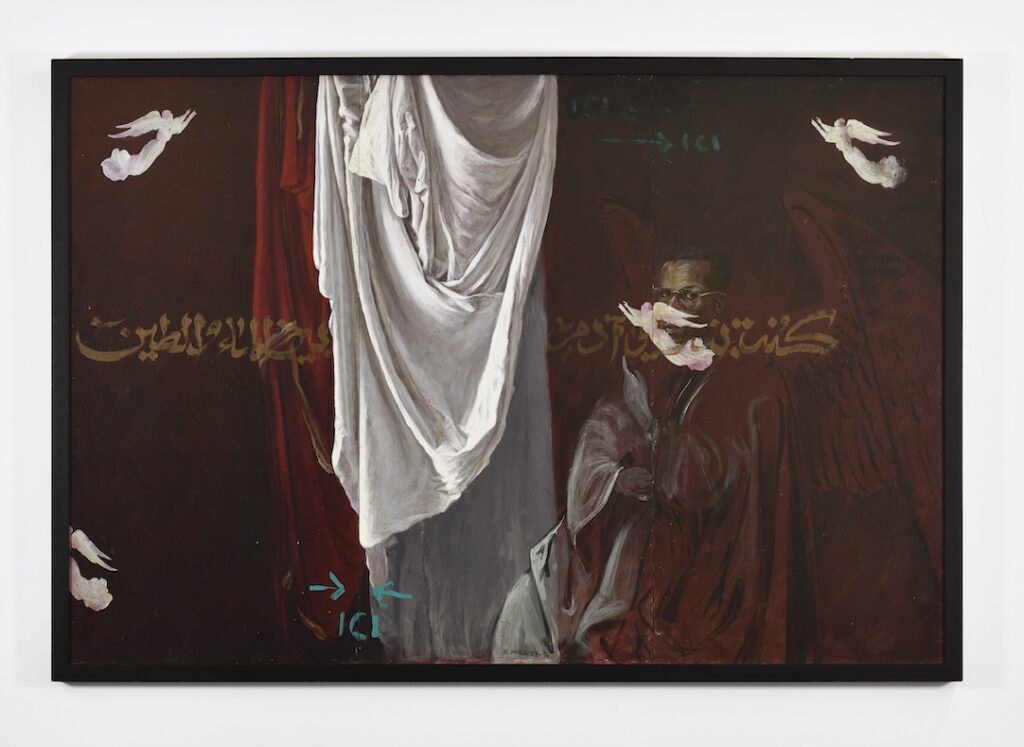
As Archangel Gabriel, dressed in an ample tunic, he is a messenger, pointing with a gesture of the hand that has evidential value to a large, empty white drapery, his impassive, insistent gaze taking us to witness a presence/absence and an undecidable place («ici?»), while cut from a Tiepolo-style sky, dressed in long, frothy white robes, four miniature angels animate the space. With his Self-Portrait with Angels (1987), Musa borrows from traditional representations of angels in European painting, while linking the three panels of the triptych with a Hadîth, in Arabic calligraphy, attesting to the anteriority of the encounter between Gabriel and the Prophet: «I was a Prophet while Adam was (still) between water and clay». Angels definitely belong to everyone.
In Ange (2002), naked and athletic, endowed with robust wings and a nimbus sketched in white paint on a Provençal fabric background, Musa holds an axe, ready, like the Archangel Michael confronting with his spear the dragon of the Apocalypse, to do battle with the miseries and scandals of the whole world, against a background of a profusion of flowers that also partially cover the image and curiously flatten it. And we'll remember that Musa has long expressed his anger at the world's present and past abjectness, «a dangerous place run by criminals».
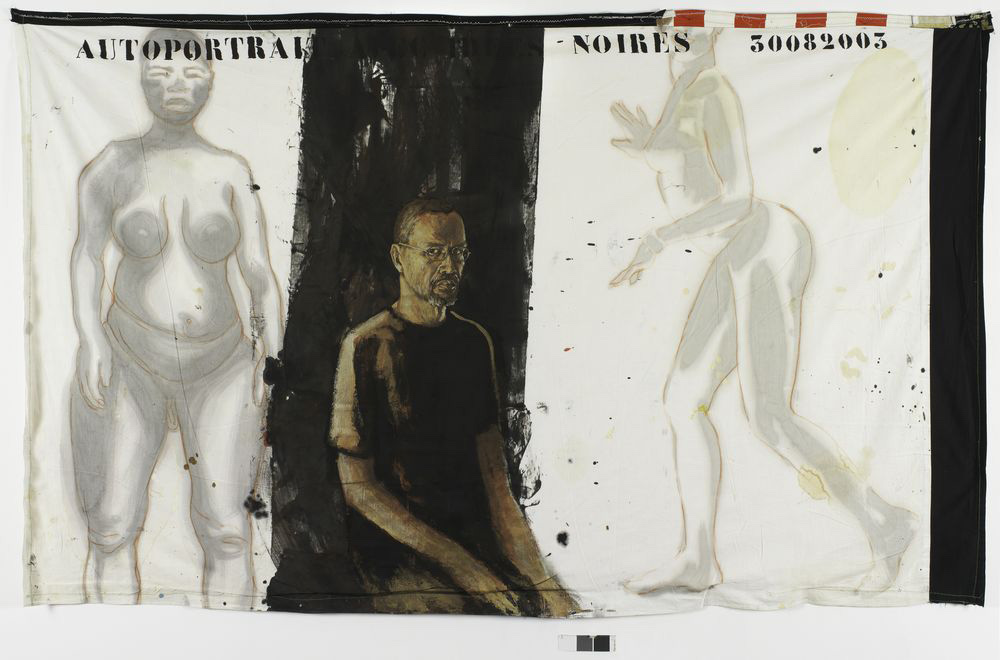
In his Autoportrait Avec Idées Noires (2003), taking the words of the title literally, he surrounds himself, this time without wings, with two female figures, each condensing in a different way the racist violence of a colonialism that invented and consumed African exoticism. One is Josephine Baker, the other Sawtche, alias Saartjie Baartman, a young girl from a South African ethnic group, absurdly described as the «Hottentot Venus», ignominiously turned into an object of «science» and fairs, here in the absolute nudity of a cast of her body.
But it's in a self-portrait multiplied into three angels, one with a Batman-like body - a reversal, give or take a few letters, of the name given to him by his predators - that he surrounds the sanctified Sawtche, against a background saturated with small drawings of 19th-century objects, evoking the artifacts of ethnographic museums long unconcerned with ethics, to the point of enriching their collections with looted places of worship and commodified bodies (Worship Objects, 2003).
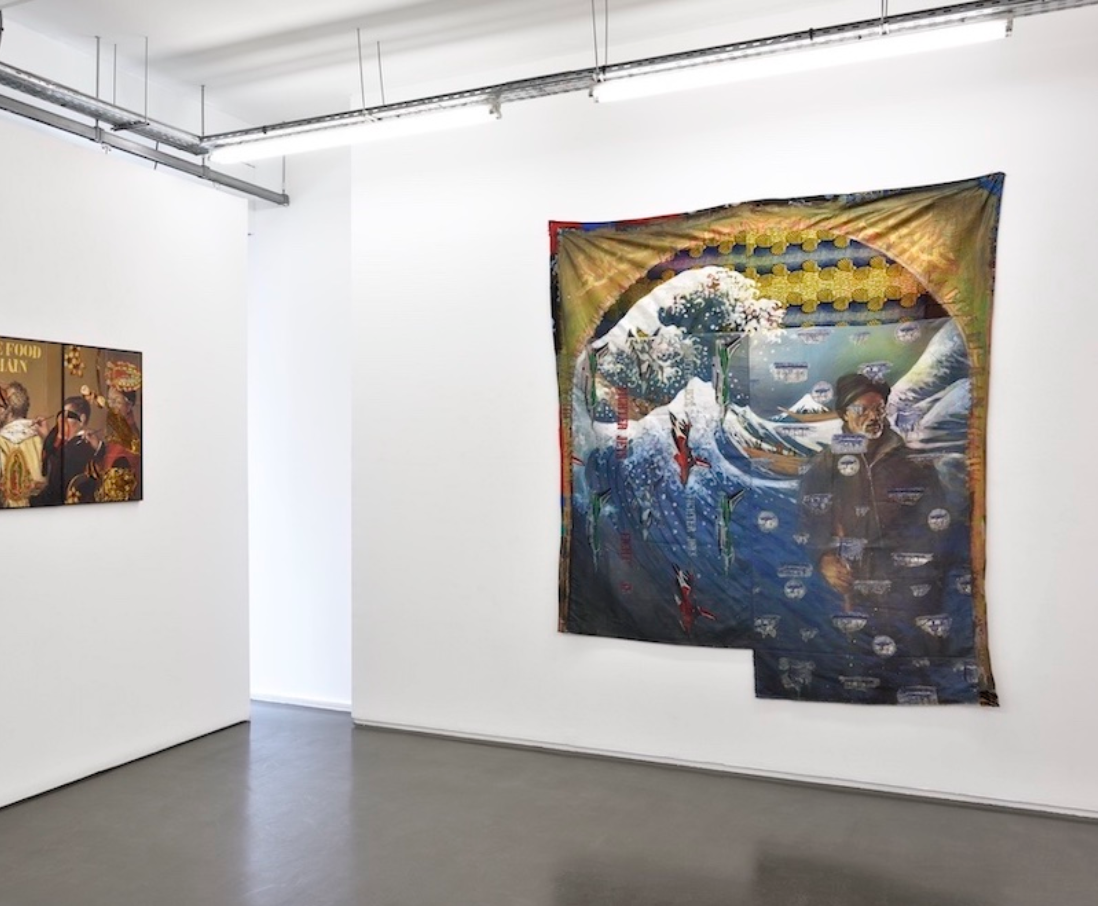
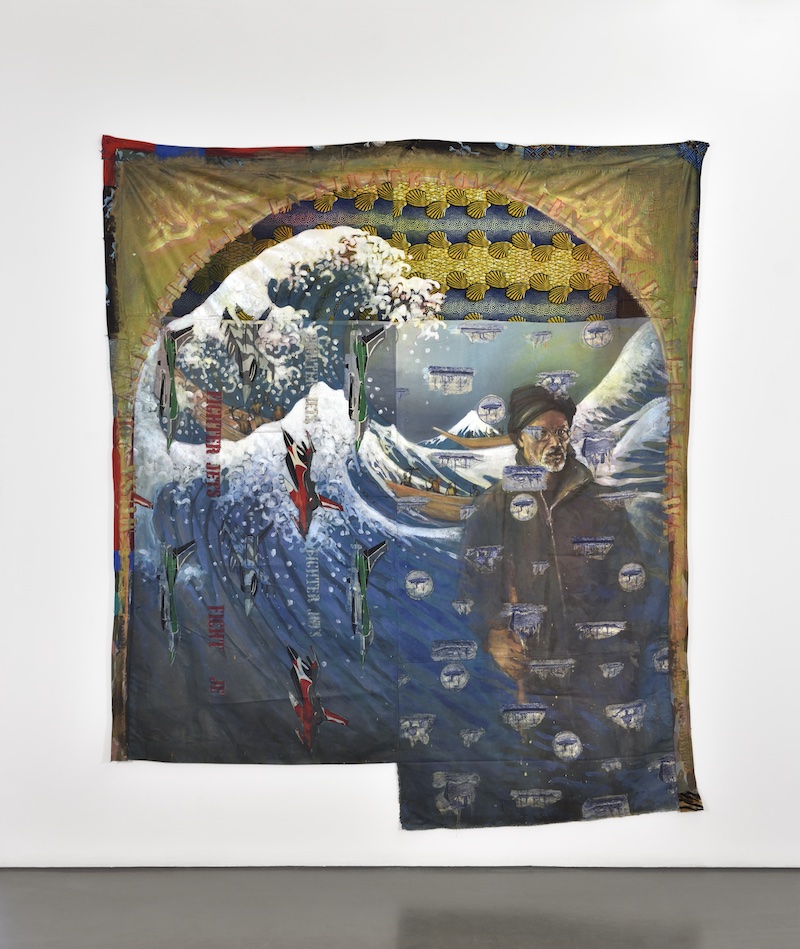
There are many other subjects of indignation. Repurposing Hokusai’s The Great Wave off Kanagawa, Musa created his Autoportrait en pirate somalien au large de Kanagawa (2015), against a backdrop of fabrics printed with fighter planes and sailing ships. But here the fragile fishing boats threatened by the raging waves in the Japanese woodblock print are occupied by Somali pirates, like those who, in the 2000s, undertook to fight against illegal fishing practiced on their coasts by boats from Southeast Asia, Iran or Europe, plundering schools of fish and destroying an essential and fragile source of income.
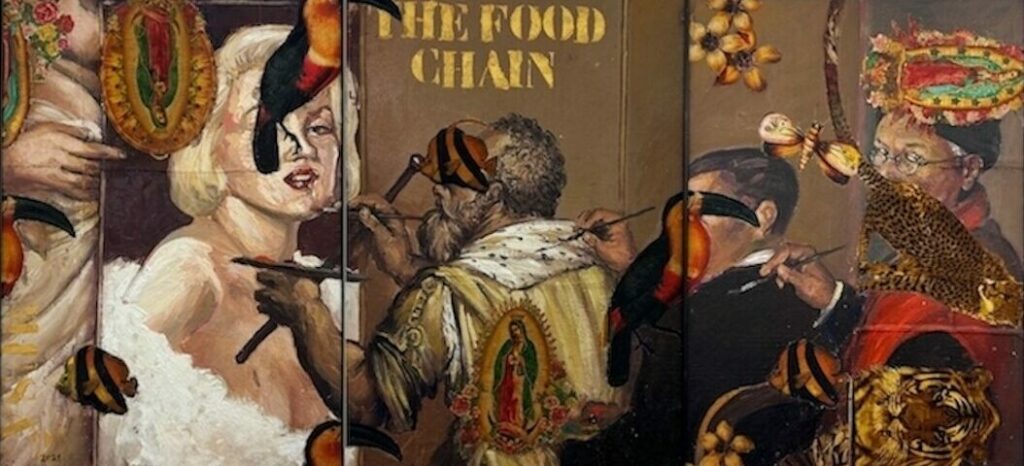
Elsewhere, we find ourselves with him gorged on sweet and colorful pastries, augmented by the portrait of the erotic and no less industrial icon that was Marilyn Monroe (Self-portrait with the Virgin Marilyn, 2020), the latter also being placed at the foundations of the history of painting and the art market, evoked in short form by the triptych The Food Chain I (tryptic), in 2021. In it, from left to right, back to back and three-quarter view, come Saint Luke - with features of Michelangelo - with brush and palette, inventing without a model not the portrait of the Virgin Mary as in Vasari's fresco, but that of a sensual Marilyn that the painter's hand-rest cane now seems to threaten, then René Magritte, in a quotation from his self-portrait La Clairvoyance (1936), and finally Musa who, while mimicking Magritte's gesture of painting on the back of Saint Luke, watches us watching him, non-dupes with him of the potential betrayal of images.
A further detail: at the very left of the painting, at the origin of the origin, off-screen, a hand with outstretched index finger indicates the direction of the gaze and, in the same gesture, holds the painted panels, making them an image within the image.
The whole is punctuated by superimposed motifs - images in the image within the image, multiplying shots with a depth effect that is the hallmark of Musa's work - toucan, tiger, cheetah or tropical fish, all endangered animals accompanied by the luminous, flowery medallions of a Virgin in glory in her mandorla/vulva. Close to Musa's face is a butterfly of the genus Yponomeuta, fragile but able to use its wings like a drum to ward off predators.
Sometimes, this great succession of borrowings and detour, which images use to invent themselves, can generate curious associations, as in Crush (Frida), 2022. In a striking foreshortening, the accident that shattered the body of the Mexican artist, who was made an icon of her own history by the great American pop art market, is evoked here by collages of comic-book onomatopoeia («Crush!». «Blaf!». «Ha Ha Ha»...). We are reminded of Roy Lichtenstein's Whaam! (1963), an ironic adaptation of a panel from Men of War, an anthology of comic-book images of war, and of the history of conflictual relations between the United States and Mexico, in a long series of annexations and border wars. But here, Musa's self-portrait rubs shoulders with the upside-down, luminous portrait of an irresistible Frida Kahlo, evoking another kind of crush, this time colored by fascination, attraction and desire.
Musa's artistic approach may be one of protest, but it is also one of play, as his titles - usually painted on the works themselves and forming part of the composition - testify.
«In his »joke" work (Self-portrait as an Impressionist, 2022), he expresses his admiration for the Impressionist painters who have been a major influence on his work in recent years.
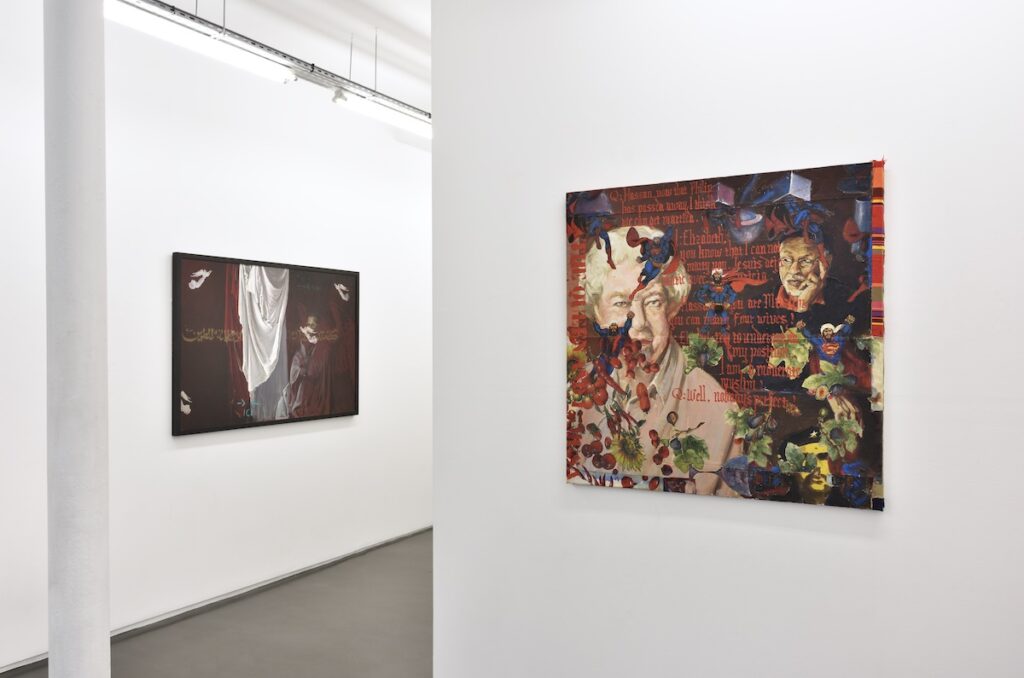
In The Queen & I (2021), nonsense is called upon for an improbable dialogue between Musa (I) and Queen Elisabeth (Q), tiny twirling effigies of a turbaned Superman, a portrait of Che Guevara, peppers, tomatoes and figs - some open and pink - superimposed on the two portraits, as is a jubilant text in red-painted Gothic letters:
Q: Hassan, now that Philip has passed away, I think we can get married. I: Elizabeth, you know that I cannot marry you. I am already married to Patricia. Q: Hassan, you are Muslim, you can marry four wives! I: Elisabeth, try to understand my position, I am a moderate Muslim! Q: Well, nobody’s perfect
Hassan Musa's not-so-narcissistic self-portraits say a great deal about him: an artist born in Sudan, trained in art in Khartoum, holder of a doctorate in art history in France, where he lives, draughtsman, painter, calligrapher, engraver, illustrator, performer, sewer, «bricoleur» and «image-maker» with a love of fabrics and colors, art critic, great reader and viewer, transformer of an inexhaustible cultural repertoire without borders.
For his Self-Portrait with Colored Ideas (2003), he is naked on a patchwork of fabrics printed with flowers, strawberries, grapes and birds, idyllic evocations that are contradicted in the background by the disturbing drips of a gigantic explosion. Heaven and hell, the life drive and the death drive, tolerance and violence. What's to be done?
Against all that confuses, traps and threatens us, Musa's self-portraits suggest possible common spaces of resistance.
Evelyne Toussaint Contemporary Art Historian Professor Emeritus at the University of Toulouse Jean Jaurès