To play Indian without losing a feather
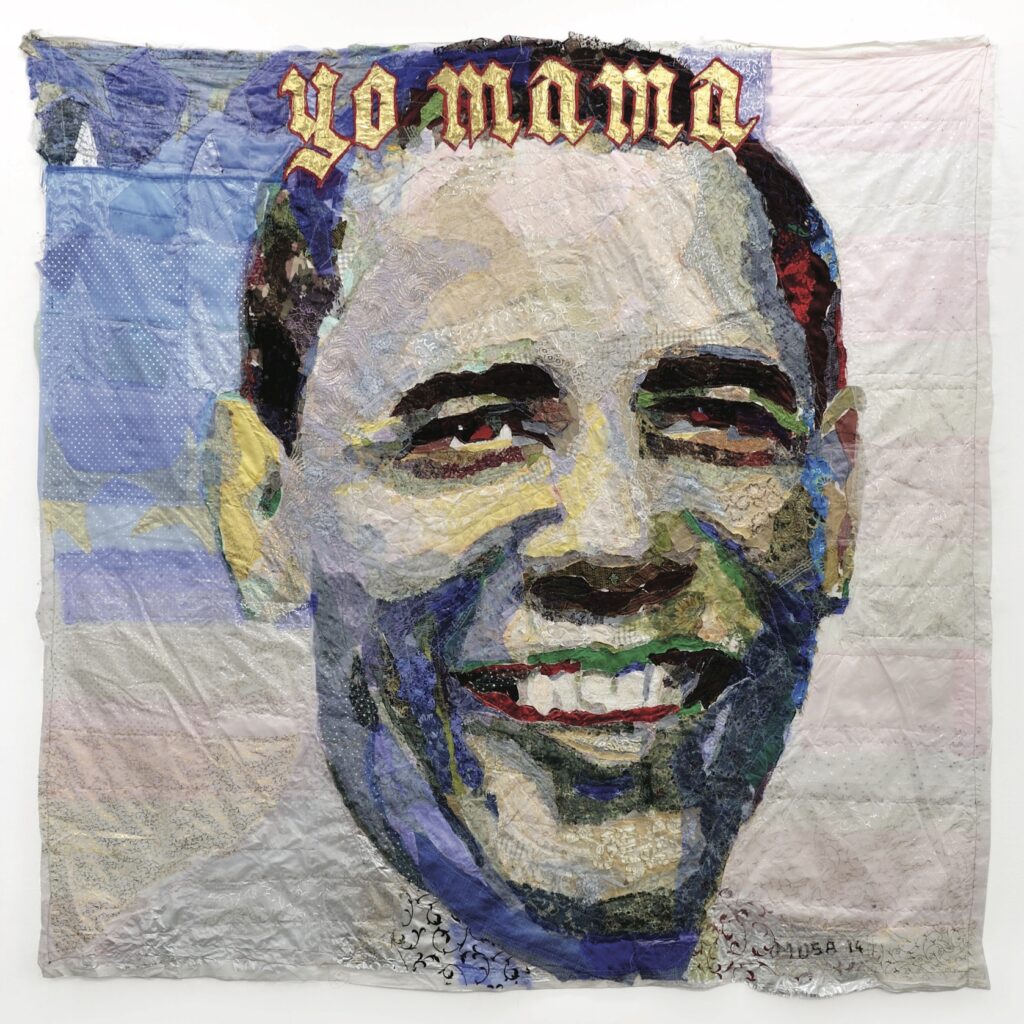
There is a very particular term in the English language that does not truly have an equivalent in French: “blank.” Its trace can nevertheless be found in French expressions such as blanc- seing (“blank cheque” or “carte blanche”) or chèque en blanc (“blank check”). Within both past and present media systems, this principle of “blankness” persists in a particularly striking way: being present while representing nothing more than a pure surface, a pure screen that is at once opaque and transparent, onto which others can project their power, their stories, their desires, or their fantasies. In other words, two opposing yet complementary forms of invisibilization: erasure and, conversely, overexposure. The current exhibition at the Maïa Muller Gallery by Hassan Musa, a Sudanese artist living in France, is closely linked to this notion. Entitled American Way of Life and Death—a title that inevitably recalls the approaches of Andy Warhol or Richard Avedon—the exhibition presents, for the first time, a series of portraits of iconic American figures whose images have become so famous and celebrated that they have ultimately eclipsed their very humanity, even the lives they actually lived, in favor of a narrative written about them, through them, but without them. Did Andy Warhol not proclaim: “Fame is like eating peanuts: once you start, you can’t stop”? Peanut pickers may appreciate the irony... The artist himself explains: “I remember that when I was a child, I loved watching Westerns. One day, I heard someone say that ‘the only good Indian is a dead Indian.’ At the time, this shocked me because I liked Indians; I thought they were more beautiful than cowboys. It also intrigued me. Later, I discovered that even President Roosevelt had, at one point, referred to this phrase. This relationship with the Indians (Native Americans) opened my eyes to the capitalist machine that crushes everything in its path, including Americans of European descent. In fact, if you reverse the phrase and say, ‘A GOOD AMERICAN IS A DEAD AMERICAN,’ it becomes shocking, because you no longer see the Indians; instead, you see the European- descended Americans who dominated America. So I titled a series of portraits ‘A GOOD AMERICAN IS A DEAD AMERICAN.’ I began with Lincoln, then Martin Luther King, Malcolm X, John Kennedy, before portraying the Native leaders who fought against the American army. A man like Geronimo, who spent his life fighting the U.S. military, ultimately died under very tragic circumstances. He had been incorporated into an American circus show called Wild West. In that show, Geronimo played the role of the Indian. He was dressed up as an ‘Indian’ and performed that role. In doing so, he became an allegorical figure for all those people who opposed the capitalist market machine but ultimately ended up being crushed by it, one way or another. Either killed by bullets, like Sitting Bull, or simply destroyed by the logic of the market.” This cynical paradox recalls Musa’s tribute to Josephine Baker, in which the artist painstakingly deconstructed the reasons why Baker chose to embody on stage an almost caricatural image of herself, only to turn that image back on itself like a glove—or a banana peel—upon which the racism of her captive audience would inevitably slip. Hassan Musa’s new paintings on fabric therefore focus, in a deliberately allegorical form, on some of these “dead Americans,” whose disappearance enables American capitalism to survive itself and continue, almost single-handedly, to produce the “glory,” the “triumph,” and the “greatness” of America. The fabrics have never been so vibrant and colorful, so joyful and shimmering, resembling parade banners. For my part, they evoke the AIDS Memorial Quilt, the “patchwork of names” created to commemorate AIDS victims, in which the popular American quilting tradition was repurposed to honor the memory of other “dead Americans” who had died in anonymity, distress, and extreme precarity. Thus, somewhere between document and representation, between a duty of justice and the preservation of identity, the artist’s monumental works emerge as celebrations rooted in the exuberance of life as opposed to the spectacle of death. As Richard Avedon once stated: “The moment an emotion or fact is transformed into a photograph, it is no longer a fact but an opinion.” In Hassan Musa’s work, the fact indeed becomes opinion; but above all, in a world obsessed with controlling beliefs, behaviors, and appearances—that “blankness” mentioned earlier—the human being joyfully regains the very fabric of reality. “Truth, Justice, and a Better Tomorrow” was the slogan of The Adventures of Superman in 1952, at the height of the Cold War. This ideal of truth and justice seems more necessary than ever today, even if I cannot truly say whether the promise of a “better world” remains effective. No matter. As long as we can still hope for brighter tomorrows.
Marc Donnadieu