ANIMA MUNDI (The Soul of the World)
The exhibition invites us to reflect on traces and imprints, lending it an enigmatic quality. Yet one word, vulnus, appears clearly on the paper. Derived from vello — to tear away, detach, uproot — it signifies a wound, an injury, a lesion. Here, these wounds are revealed rather than displayed, emerging discreetly, here and there, with a delicate visual sensibility that in no way conceals the strength of a sustained exploration of memory and healing. The red threads of history trace out a geography.
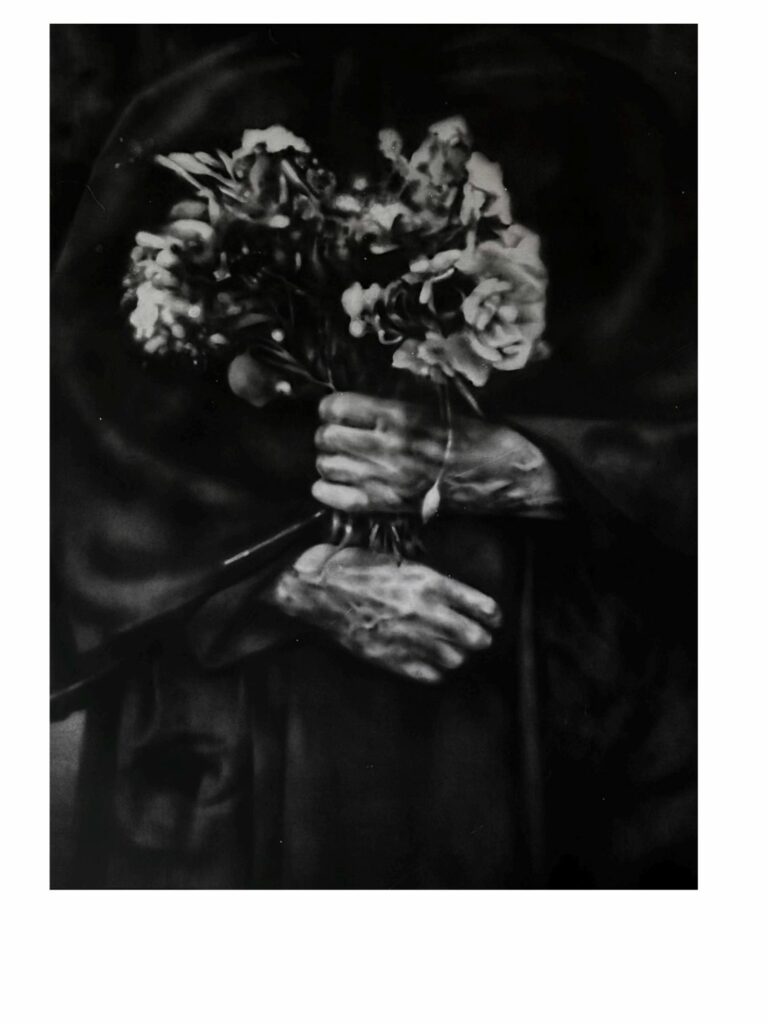
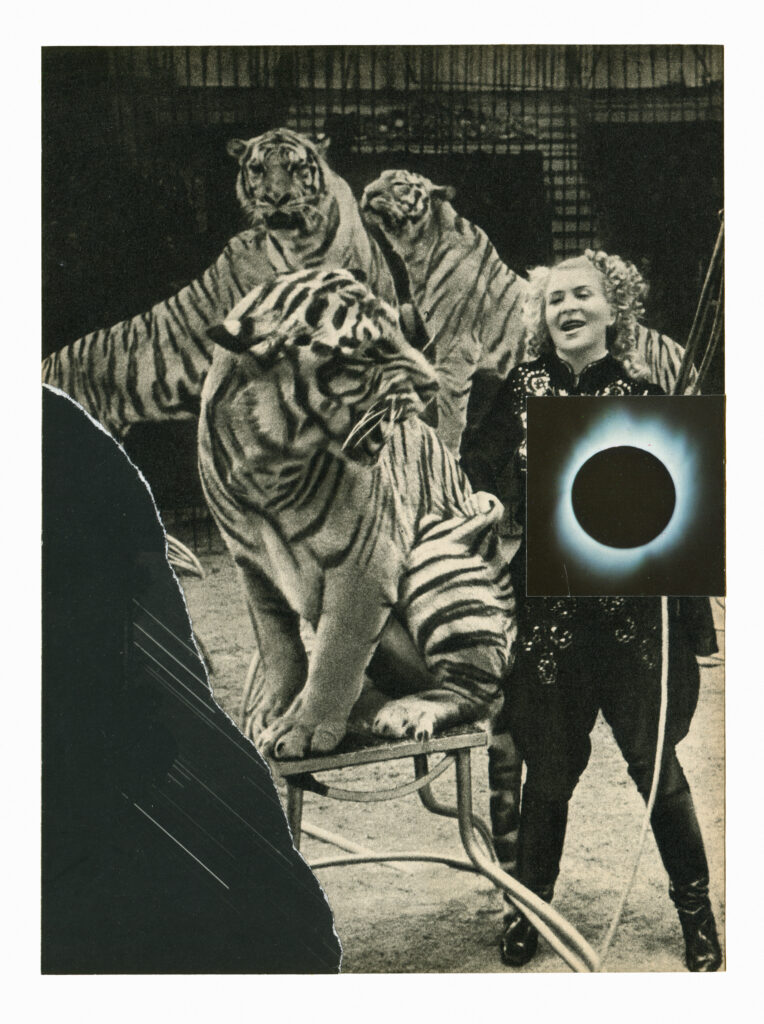
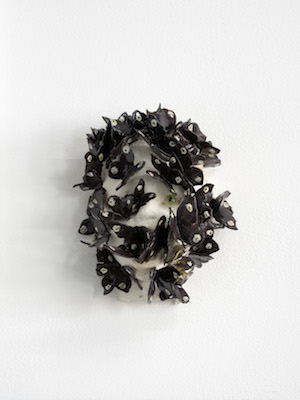
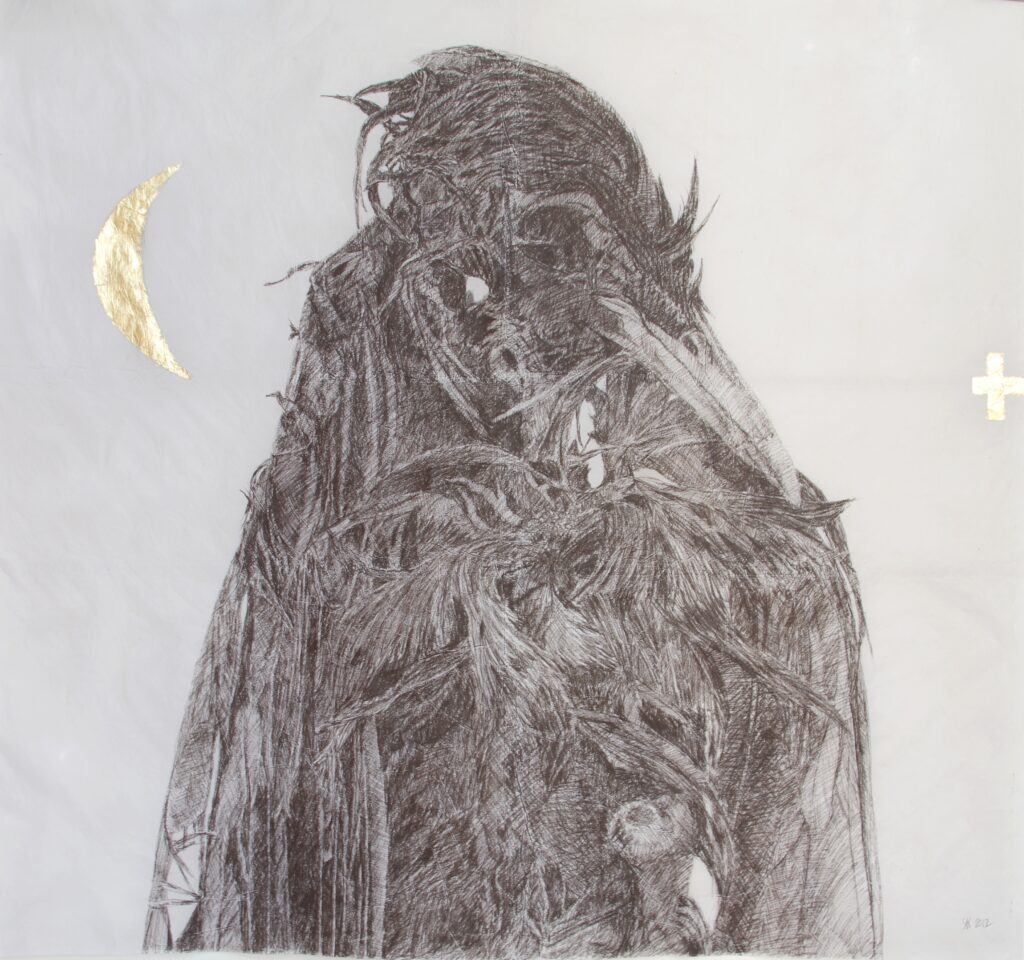
The artist once appeared, with a wounded body and skin that was pricked like in her paintings. Sculptures in wood (1999-2000). Now, the overlapping leaves reveal figures through a blind massage, by memory. As on the skin, Stigma, The sting, the puncture, will leave a mark: a scar or a cicatrice. For there will always be traces of what happened. In the series La Mademoiselle, The buvard, whose back is visible, has absorbed liquids and various substances. La Mademoiselle ? A mystical ritual. The burnt dry leaves The Autodafé refers to the destruction of kotas by the Christian missionaries, by fire. And their desecration.
What happens in Gabon when someone passes from life into death? Mourners weep and sing for the dead, whose presence is affirmed by relics and bones (Demi-pays, reliquia ex ossibus). And because the mourners are alive, they rise again. Tears flowing down cheeks, ink spreading across canvas or blotting paper, water running along a riverbed, words entering the ear: what is it that permeates us? Language, first and foremost. The artist moves between languages, from Punu to French, two living languages, and Latin to Greek, two ancient tongues.Half-country, relics from the past). And because they are alive, they rise up. Tears flow down their cheeks, ink on the canvas or the buvard, water in the riverbed, words in the ear; for what are we imbued with? First of all, language. The artist moves from one language to another, between punished and French, two languages of today; Latin and Greek, two archaic languages.
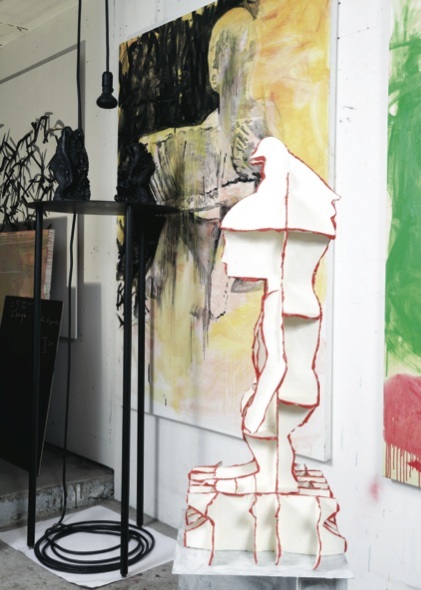
The pictorial superimpositions, like palimpsests, refer to the liber, the inner bark of the tree on which the women of Gabon record, one after the other, the chronicles of existence. What is retained from the passing time. What is imprinted in each one. That is why, plastically, in this patient work of shaping the materials, the imprint is king. The clays named Matsanga (tears) / Ngongo (the weeping) thus bears the marks of the fingers and the gesture. In a sense, Myriam Mihindou starts from the other side of the world, from her sensitive metamorphoses. From bodies. And from opacity.
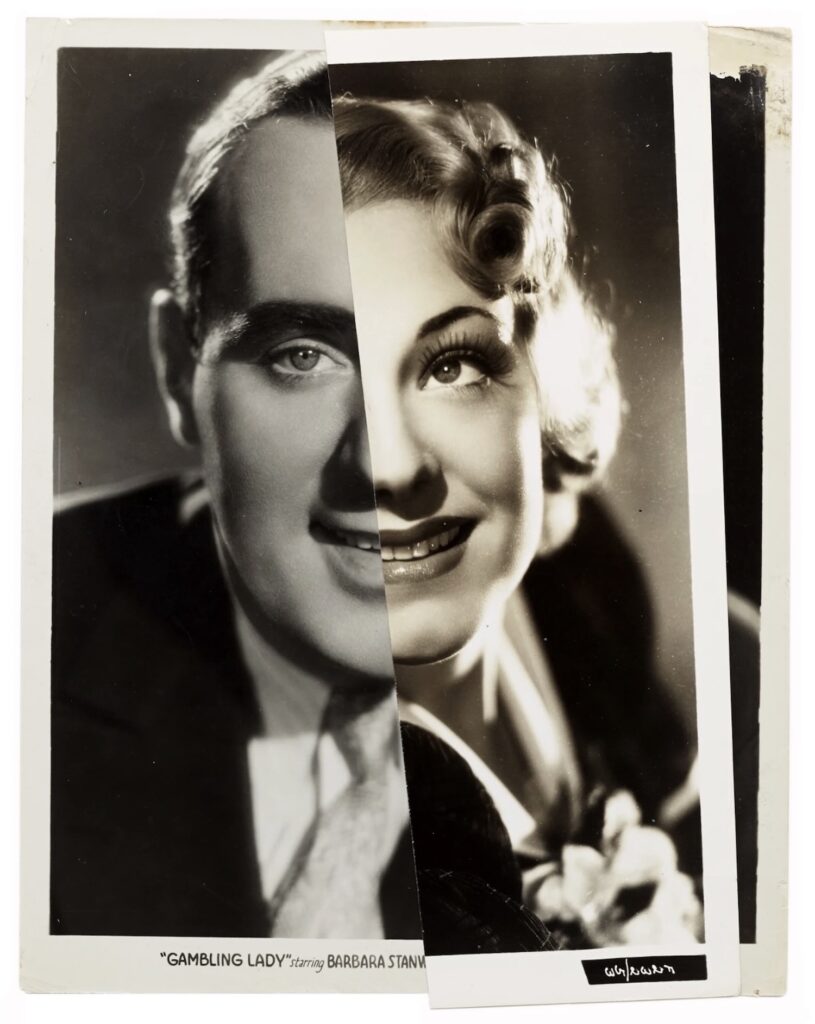
A form of meditation unfolds here, between what remains and what is yet to come. Myriam Mihindou’s work is permeated by transitions and metamorphoses. The deliberate blurring of outlines, the assembling and layering of papers and fabrics, reveal the invisible and the limits of perception. Somewhere between suggestion and revelation, the artist invokes Janus, the enigmatic two-faced god, looking both backwards and forwards, towards what came before and what comes after.
Seloua Luste Boulbina
A pagan prayer
When Teshome Gabriel likened our memory to a heap of ruins, he was alluding to the impossibility of remembering the past faithfully. Memories are traps that we must continually reconstruct and question, time and again, whether in moments of happiness or of profound sorrow. For her latest exhibition, Myriam Mihindou has chosen to explore this unreliable, deceptive memory; a memory that continually eludes us as time passes. In her quest, she acknowledges the impossibility of her undertaking and offers us, rather than historical reconstructions, traces, wounds and traumas — the unspeakable scars left by world history, and particularly by the relationship between the West and Africa. And so the artist sets out to salvage whatever can be saved, to feed the flames with whatever she can find, so that oblivion does not take hold once and for all. As in Ruine préfiguration, and in many other works, she turns to collage and assemblage. Using tracing paper and blotting paper, she evokes the permeability of what we believe we know. She reveals the sometimes contradictory layers that make us who we are, held together by a process of sedimentation that extends far beyond our individual existence. This exhibition is a pagan prayer, a meditation on what remains when everything threatens to sink into indifference. It speaks with remarkable insight into the world in which we live. A planet where fury has displaced reflection and solidarity. The exhibition is a meditation, an invitation to suspend time and immerse ourselves in slowness, amid the flames of destruction and the tears, under the watchful and benevolent gaze of the Mademoiselles, who show us the way.
Simon Njami